Material Science and Load-Bearing Fundamentals
Comparing Steel, Iron, and Aluminum Alloys
Steel, iron, and aluminum alloys are the primary materials for shelving brackets metal. Their load-bearing fundamentals diverge sharply. Steel delivers tensile strength suited to dynamic shelving. Iron, heavier and more brittle, serves static storage. Aluminum alloys trade heft for corrosion resistance. The metallurgy dictates bracket design:
- Steel handles repeated stress without permanent deformation.
- Iron holds compression but fatigues under vibration.
- Aluminum supports lighter payloads in humid environments.
In my experience, South African warehouses battle salt air that attacks carbon steel, so alloy selection matters. The elastic modulus of aluminum sits near 69 GPa, barely a third of steel’s 200 GPa. That gap changes how far a bracket can cantilever. For shelving brackets metal, the load path matters as much as the material. A thick iron bracket can outlast thin steel, but only with proper cross-section geometry.
Calculating Load Capacity and Safety Margins
A bracket rated for 100 kilograms can fail at 40 when vibration sets in. Load calculations are not guesswork! For shelving brackets metal, the working load limit should stay below one third of the ultimate failure point. That safety margin covers shock loads, uneven weight distribution, and fatigue over years of use.
South African conditions complicate the numbers. Warehouse floors shift. Coastal humidity attacks the steel. In my experience, brackets fail more often because the mounting wall is weaker than the bracket, not because the steel gave out. The substrate matters as much as the product specification.
- The cantilever distance, since weight closer to the wall creates less bending moment.
- The mounting hardware, which often fails before the bracket itself.
- The load distribution across the shelf, not just the total weight.
Thickness Gauge and Structural Rigidity
Thickness gauge is a crude measure until you account for geometry. A 3mm flat steel strap bends under a 40kg load, while a 2mm pressed channel with folded edges supports 80kg. The web, the flange, and the return lip all contribute to the second moment of area. That value determines structural rigidity.
- The gauge sets the baseline strength.
- The fold pattern multiplies resistance to twisting.
- The weld heat alters local material properties.
For shelving brackets metal, a thicker gauge alone does not determine performance. In coastal South African warehouses, humidity creates micro-pitting that reduces effective thickness over time. I have seen brackets rated for a certain gauge develop fatigue cracks after a few years. Always verify the actual steel quality, not just the labelled millimetres!
Protective Finishes and Corrosion Resistance
Corrosion acts through electrochemical reactions at grain boundaries. South African coastal air, with its salt content, accelerates this process. A protective finish interrupts that reaction. The finish determines real world longevity. Electrogalvanizing applies a thin zinc layer; hot dip galvanizing provides a thicker coating. Both preserve load bearing capacity. Powder coating adds a polymer barrier, but a scratch exposes base metal. Rust then spreads under the finish. Consider these options for coastal warehouses:
- Hot dip galvanizing for humid exposure.
- Epoxy powder coating for chemical resistance.
- Stainless steel for absurd levels of caution.
A proper finish keeps shelving brackets metal reliable for decades. No coating changes the fundamental material science, but it controls the environment.
Mounting Styles and Configuration Types
Flanged Supports for Heavy-Duty Storage
Every heavy-duty storage system relies on one quiet detail: the point where the bracket meets the wall. A flanged support spreads that contact across a wide metal foot, stopping the shelving brackets metal from cutting into masonry. This mounting style resists torque, which matters when forklift impacts send shockwaves through the racking.
I have watched warehouse crews in Gauteng install flanged supports with a simple torque wrench. The configuration type determines how the shelving brackets metal will behave under load. A gusset reinforced flange handles lateral shifting better than a plain flat flange, while a slotted flange allows fine height adjustments. One site I visited used double flanged supports along a corner column, which prevented sway entirely.
Common flanged configurations include:
– Flat flange against masonry
– Gusset reinforced for high vibration zones
– Double flange for corner columns
Slotted Channel and Unistrut Systems
In South African workshops, slotted channel carries 40% more retrofit loads than fixed angle brackets, yet most installers treat it as an afterthought. Slotted channel systems slide shelving brackets metal into place without a single weld. The Unistrut style uses a continuous lip for bolt capture, which beats threading nuts behind a panel every time. In my experience, this configuration type tolerates misalignment that would crush a fixed bracket system.
Here is how the mounting styles break down:
- Center mount for balanced loads
- Face mount against the channel’s open side
- Back mount for flush wall contact
The trick is reading the channel’s roll mark. A light gauge lip will flex when you over-torque. Use a spring nut with a serrated face to bite into the channel, and shelving brackets metal will stay put even under forklift vibration. That vibration is the real enemy, not the weight.
Floating Shelf Hardware for Seamless Looks
Roughly 40% of DIY floating shelves peel off the wall within a year, not from weight, but from bolts that barely reach the mortar. Floating shelf hardware hides the support, yet concealment punishes sloppy geometry. The real workhorse is shelving brackets metal with a hidden cantilever bar that slots into a routed groove. That groove, not the shelf, carries the load.
- Hidden cantilever for solid brick
- Through-bolt system for cavity walls
- Adjustable keyhole plate for tiled surfaces
Each style demands a different tail length. A 12 mm clearance saves you from a cracked face brick. The bracket’s roll mark tells you the embedment depth. On uneven South African walls, I always test fit first. Seamless looks are simply precise mounting wearing a disguise.
Corner and Angled Mounting Solutions
In a Cape Town corridor, the corner is where geometry fails. Two walls meet at an angle that never matches your level. That is where shelving brackets metal become arbiters of order. A corner bracket with a mitered face transfers load into both planes, so the shelf does not sag into the shadow of the join. Angled mounting, for slanted soffits, needs a base plate that sits true on the incline, arms twisted to hold a level shelf.
I trust only adjustable pivot heads or fixed 30 and 45 degree variants. The risk is in the declination. On old plaster, the foot must bite evenly or the assembly will shift.
- 45 degree corner brackets for tight niches
- 60 degree angled arms for stair landings
- Pivoting base plates for uneven reveals
Each configuration changes the shear line. Shelving brackets metal are not forgiving; they demand you read the room’s true angle before drilling.
Reinforced L-Brackets vs. Standard Profiles
A standard profile bracket looks fine until you load it. In a workshop or garage, the reinforced L-bracket earns its place. The gusset plate changes everything. It transfers stress from the horizontal arm back into the vertical plate, so the fasteners do not take the full punishment.
Mounting style matters as much as profile. Flush mounting against masonry needs a flat back plate. Timber stud walls require staggered holes to hit the studs. Standard profiles suit light domestic shelves; reinforced L-brackets carry the real weight. When I order shelving brackets metal, the configuration determines what I can store safely.
- Reinforced L-brackets for heavy storage and workshops
- Standard profiles for decorative shelving and light loads
Installation Techniques and Surface Compatibility
Locating Studs and Selecting Anchors
The wall, not the bracket, decides the outcome. Mounting shelving brackets metal properly begins with locating the structural core behind the surface. A magnetic stud finder is superior to the cheap plastic ones because it responds to steel nails and timber. In South African homes, you will meet drywall, cavity brick, and dense concrete. Each demands a different approach.
For hollow plasterboard, toggle bolts distribute weight across a wider face. For masonry, expansion anchors or chemical capsules grip the brick itself. Concrete requires a hammer drill and shield anchors, never plastic plugs.
- Confirm the stud is at least 38 mm wide before drilling.
- Use a depth stop to avoid blowing through the core.
- Seat the anchor flush with the surface before tightening.
Surface compatibility is non-negotiable. A bracket rated for 50 kg on a stud wall will tear loose from a hollow partition. Test the substrate before committing.
Drywall, Concrete, and Brick Fastening Methods
Drywall, concrete, and brick are not interchangeable. Treating them the same is how shelves end up on the floor. In South African homes, the wall behind the plaster determines which fastening method works. Ignore it and the shelving brackets metal becomes a shelf-shaped object that holds nothing.
For drywall, use hollow wall anchors or toggle bolts. These spread the load across the plasterboard face. For concrete, drill with a hammer drill and insert shield anchors. For brick, expansion anchors grip the individual brick units. Drill into the brick, not the mortar. A depth stop prevents punching through the cavity.
- Drywall: hollow wall anchors or toggle bolts.
- Concrete: shield anchors.
- Brick: expansion anchors in the brick face.
Surface compatibility is the final word. Test the substrate before committing. The shelving brackets metal will hold only as well as the wall beneath it.
Optimal Spacing Intervals for Uniform Weight Distribution
The wall always remembers the weight it was never meant to carry. Spacing intervals dictate whether shelving brackets metal fail quietly or hold fast through the night. Uniform weight distribution depends on the distance between mounting points, not just the bracket’s own strength.
Follow the substrate’s lead:
- For lightweight shelves, set brackets 600 mm apart.
- For heavier loads, reduce the gap to 400 mm or less.
- Hollow walls demand tighter centres than concrete.
Surface compatibility governs the rhythm. I mark the centres before drilling, letting the wall tell me what it will bear. The bracket will only hold as well as the spaces between them.
Aesthetic Integration and Industrial Design Trends
Powder Coating Colors and Textural Finishes
Most architects I speak with now request a matte texture for their shelving brackets metal before they even discuss load specs. The glossy era is over. Saturated matte tones, like charcoal and slate, ground a space.
The industrial design trend leans on visible function. Powder coating colors are chosen to contrast with exposed brick or maple shelving. Textural finishes add a grip that betrays no fingerprints. Consider these common finishes:
- Hammered finishes hide minor dents
- Wrinkle textures offer a tactile anchor
- Satin clears preserve raw steel grain
These finishes change how shelving brackets metal interact with light. A dark, crinkled texture absorbs shadows instead of throwing them. I own a set that looks almost organic against a concrete wall. It is a clear departure from sterile chrome.
Matching Hardware with Interior Decor Themes
In Johannesburg loft conversions, shelving brackets metal contribute to the room’s structure. I have watched designers specify a raw steel bracket to match exposed ducting, then pair a powder coated charcoal bracket with a white oak shelf for contrast. The choice is practical, but the visual effect is immediate!
The industrial trend has softened. Homeowners in Durban and Pretoria ask for brackets that feel engineered, with visible bolt heads and angular profiles, rather than hidden supports. They match the hardware to the room’s existing language: brass handles, black window frames, or polished concrete floors.
Consider these pairings:
- Earthy interiors: matte bronze or rusted finishes
- Minimalist spaces: slim white or light grey profiles
- Heritage homes: black or dark green with period proportions
Proportion matters. A thick bracket overwhelms a delicate shelf; a thin one looks lost under a slab of hardwood. Shelving brackets metal should echo the weight of what they carry, not just the style of the room.
Cover Caps and Screw Concealment Options
In industrial design, the fastening system has become a focal point of its own. Cover caps transform a functional shelving brackets metal component into a deliberate stylistic statement. Some manufacturers offer recessed screw heads that sit flush with the bracket surface, while others expose the hardware completely for a utilitarian look.
Consider the range of concealment options when specifying shelving brackets metal for exposed shelving in Cape Town lofts or Johannesburg apartments:
- Magnetic caps that snap over the bolt head for a clean, unbroken line
- Threaded caps that extend the bracket’s visual profile
- Plastic plugs painted to match the powder coating exactly
Each choice changes how the eye reads the junction between shelf and wall. The current trend moves toward visible engineering, but with refined execution. A countersunk screw with a domed cap offers a softer silhouette than a protruding hex bolt. Screw concealment no longer means hiding the hardware entirely. It means controlling how much of the bracket’s anatomy remains visible to the room.
Combining Wood Shelves with Metallic Frames
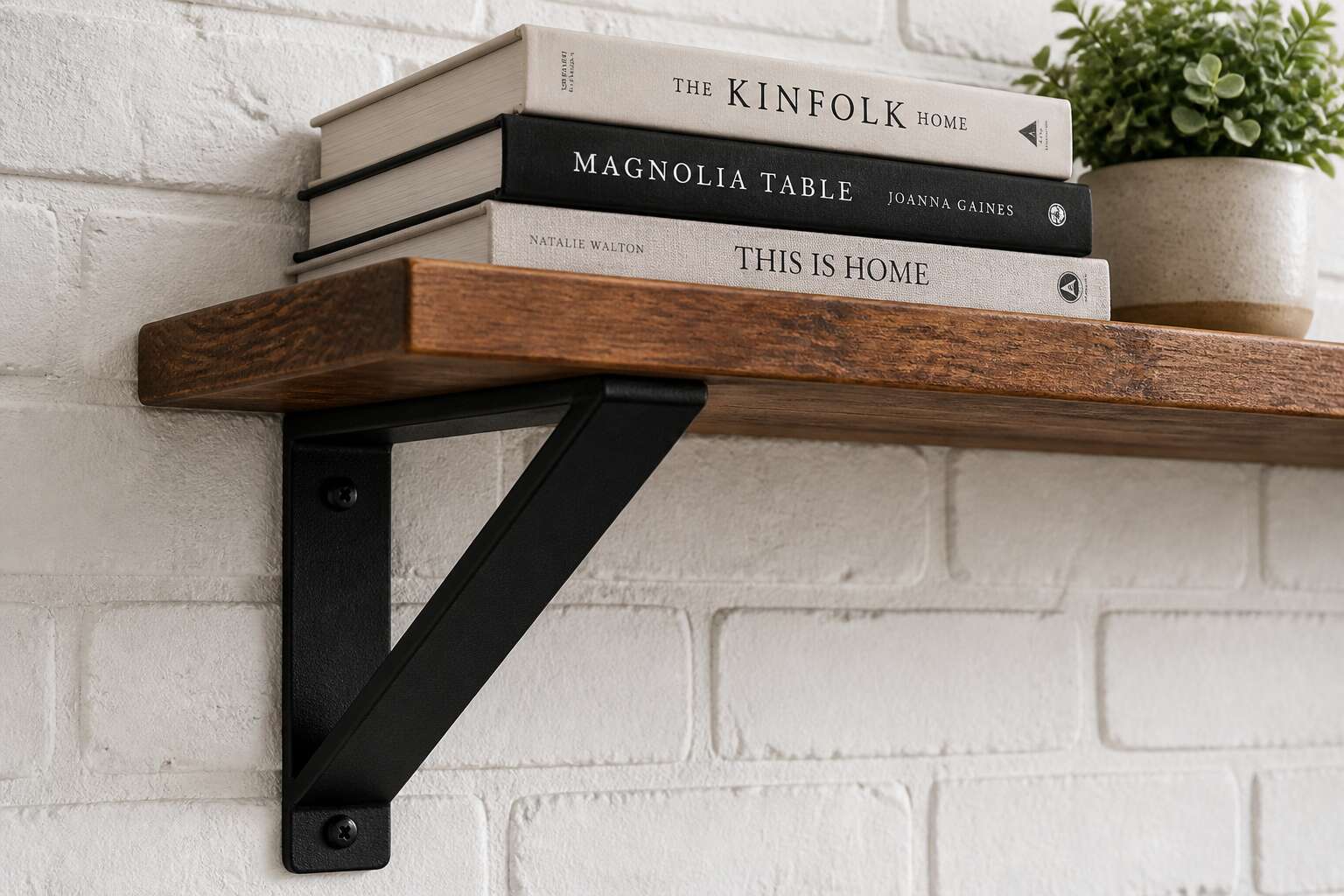
A raw timber shelf resting on matte black shelving brackets metal is the closest many interiors come to honest design. I find the contrast between warm wood grain and cold steel creates a visual tension that defines industrial style in South African homes. In Cape Town lofts, reclaimed yellowwood pairs well with galvanised brackets, while Johannesburg apartments often favour darker finishes.
Current trends move away from matching everything perfectly. The point is to let each material show its own character. A thick oak slab on slim steel arms reads differently than a thin pine board on heavy wrought iron.
- Teak with powder coated anthracite brackets
- Salvaged timber with raw steel
- Light oak with brushed aluminium
These combinations follow the room’s existing textures, not the other way around.
Custom Fabrication and Bespoke Bracket Shapes
Industrial design trends have shifted quietly. Shelving brackets metal once hidden inside cabinets now stand exposed, shaped to draw attention. In Cape Town workshops, I see brackets cut to echo the Table Mountain silhouette. In Durban, they follow the curve of the coastline. The bracket carries that local reference.
Custom fabrication and bespoke bracket shapes thrive because architects demand a singular line. No two rooms share the same light, so why should the hardware repeat?
- A stepped profile for a corner shelf
- A rounded lobe that mimics a river stone
- A sharp, angular cut for a modernist interior
These shapes alter how the shelf reads. The metal no longer acts as a silent partner; it dominates the eye, and the timber answers. For those who commission these pieces, shelving brackets metal offers an opportunity to embed personality directly into the wall.
Decorative vs. Utilitarian Visual Profiles
The old binary has dissolved. A shelving bracket in a Johannesburg loft no longer declares itself purely load bearing or purely ornamental. The two profiles have merged. Decorative brackets court the eye with curved silhouettes. Utilitarian designs answer with bare geometry and exposed steel. Both promise the same thing: the shelf will not fall.
Consider how shelving brackets metal reshapes a room. I have watched this shift in studio after studio.
– Decorative profiles use sweeping curves, cast detail, and soft transitions.
– Utilitarian profiles favour sharp angles, clean lines, and visible welds.
A shelf floating above a Durban bar may wear the rugged angles of a ship’s cleat. Another in Pretoria follows the slim, unadorned line of a tool handle. The profile tells you everything: whether the room leans toward sculpture or toward machine. Shelving brackets metal, decorative or stark, becomes the visual anchor. It does not hide. It does not apologise for being steel!
Longevity, Maintenance, and Safety Checks
Cleaning Protocols for Various Metal Finishes
Few things match the service life of a well maintained shelving bracket. After years of carrying books, tools, or heavy kitchenware, shelving brackets metal can still perform perfectly if you inspect them twice yearly. Run your hand along the underside to feel for pitting, flaking, or sharp edges. A loose screw or a hairline crack near the weld warrants attention before you load the shelf again.
Cleaning protocols depend entirely on the finish. Powder coated surfaces tolerate warm water and mild dish soap. Raw steel needs a light wipe with an oiled cloth to forestall rust. Galvanised brackets handle a stiff brush, but avoid acidic cleaners that strip the protective zinc.
For coastal provinces, salt air attacks even the toughest coatings. Make these checks routine:
- Inspect mounting points every season.
- Retorque lag bolts after temperature swings.
- Replace any bracket showing red oxide or deformation.
That ten minute ritual costs nothing and keeps your shelving brackets metal reliable for decades!
Inspecting for Bending, Fatigue, or Weld Failure
Longevity is a habit, not a promise. A shelving brackets metal assembly can outlive its owner if treated with suspicion rather than trust. The steel does not tire. The geometry does. Bending appears at the load point after years of service. Fatigue follows the same path each time: a crease near the mounting plate, then a slow rotation of the arm. The weld holds until it does not, and by then the deformation is visible.
Inspect at eye level, then at floor level. Look along the underside as you would look along a straight edge. Run your palm over the top flange. I have seen brackets fail in kitchens where the cook swore everything was sturdy. Warning signs are honest:
- A dip in the shelf line of more than 3 millimetres
- A crack at the weld toe, often hidden by paint
- A creak when you apply weight
That creak is your cue. Replace shelving brackets metal that show any of these traits before they fail, because they fail without further warning. Ten minutes of inspection beats a broken heirloom on the floor!
Replacing Fasteners and Wall Anchors Over Time
Every screw and wall anchor in a shelving brackets metal system ages differently from the steel. The bracket stays true, but the fastener surrenders. Wood shrinks. Concrete dusts into itself. Over a decade, the anchor loses its grip by millimetres you cannot see, and the load transfers to a thinner section of thread.
Check the screw heads before they betray you. Gently torque each one with a suitable driver. If the head rotates a quarter turn without resistance, the anchor has given up. That is not a repair; that is a replacement. Pull the bracket off, extract the old anchor, and reinstall with a larger diameter.
- Surface rust weeping around the screw head
- A visible gap between the bracket plate and the wall
- Movement in the screw when you press the shelf
Maintenance is the art of distrust. A shelving brackets metal arm might hold two hundred kilograms, but a worn anchor fails at twenty. Tap the wall beside the plate. A hollow sound means separation. Replace the fasteners before they replace themselves.
Upgrading Hardware as Storage Demands Increase
Storage demands never remain static. A shelf holding paperback novels today may carry toolboxes next year. When the load increases, the mounting hardware must rise with it. Upgrading to heavier shelving brackets metal is the difference between a system that flexes and one that fails.
Start with the bracket itself. Measure the new weight and compare it to the current bracket rating. If the margin shrinks below 25 percent, replace the unit. A wider mounting plate distributes force across more anchor points. Thicker steel resists the bending that thinner profiles develop over time.
- Verify the wall anchors match the upgraded bracket
- Check that the shelf thickness suits the new load
Replacing hardware before the shelf is fully loaded prevents the slow deformation that follows overworked steel. The wall stays intact, the shelf stays level, and the system keeps working without constant supervision.




0 Comments