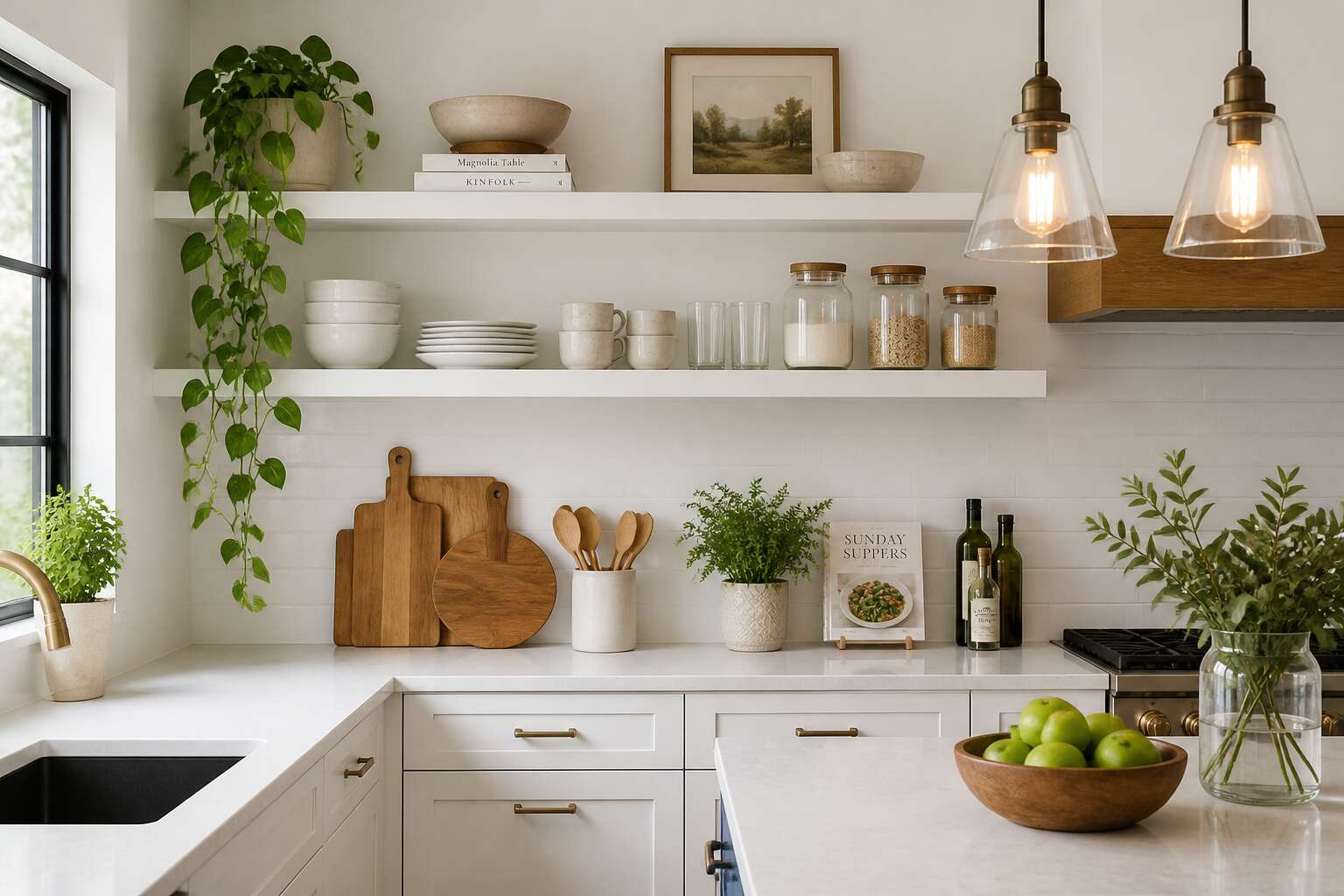
Benefits of Open Shelving in Kitchens
Maximizing Small Spaces
South African homes often grapple with kitchens where counter space is a luxury. Open shelving changes that calculation by converting wasted wall area into functional storage. These kitchen open shelving ideas prioritise visibility, so everyday crockery stays within arm’s reach without cramming cupboards. Removing bulky upper cabinets instantly lightens the visual load, which lets natural light bounce further across the room.
The benefits extend beyond aesthetics. Open shelving forces a disciplined curation of cookware, which naturally reduces clutter. You see what you own, so you buy less duplicate equipment. This approach also lowers renovation costs, since sturdy brackets and reclaimed timber cost far less than custom cabinetry. For any kitchen open shelving ideas you consider, the focus stays on utility.
Consider these practical advantages:
– Quick access to frequently used pots and spices
– Easier cleaning behind and around stored items
– Flexibility to rearrange displays for seasonal decor
When space is tight, every centimetre matters. Open shelving transforms an awkward corner into a display nook, and that small shift makes the entire kitchen feel larger and more intentional.
Easy Access to Everyday Items
Reaching for a coffee mug first thing in the morning should not require an extensive search. Open shelving places everyday items at eye level, so the things you use most stay within arm’s reach. This accessibility transforms kitchen open shelving ideas from a decorative trend into a practical morning ritual.
You see your supplies at a glance. No more rummaging behind plastic containers to find the turmeric. The visibility prevents duplicate purchases and reduces food waste, because forgotten items remain exactly where you left them.
The real benefit shows in daily routines:
– Mugs and glasses sit ready for the first coffee of the day
– Cooking oils and spices stay within easy reach while the stove is hot
– Everyday plates are accessible without opening heavy cupboard doors
These kitchen open shelving ideas prioritise function through simple proximity. Your workflow speeds up, and the kitchen becomes a more fluid space to move through.
Visual Lightness and Airiness
Upper cabinets can block a room’s natural light. When you replace bulky doors with open shelving, the eye travels further and the wall seems to recede. This visual lightness makes a kitchen feel larger without changing the floor plan.
The advantage becomes clear in narrow galley kitchens and open-plan living areas. Without door fronts, visual clutter drops away. Textured crockery, glass jars and stacked bowls carry the aesthetic instead of cabinet hardware.
Consider what this shift does for a breakfast nook or a sun-drenched Cape Town apartment:
– Pale timber shelves reflect warm light across the room
– Glassware and ceramics create points of interest
– The eye rests on the objects themselves, not on hinges
These kitchen open shelving ideas change the atmosphere. The room feels lighter and quieter, yet storage remains substantial.
Encourages Mindful Decluttering
Open shelving forces a daily confrontation with every item you own. Without cabinet doors, there is no hiding place for clutter. Each object sits in plain view.
In a Durban cottage, I helped a friend sort through her kitchen after she removed the upper cupboard doors. She found three identical olive oil bottles and a collection of chipped plates. The discards came quickly. What remained was a purposeful set of tools for cooking and serving.
The process reveals specific categories for the donation pile:
- Duplicate utensils that never get used
- Packaging that once held a shipping box
- Glasses with cracks you forgot about
This is the quiet benefit of kitchen open shelving ideas. The shelves prompt you to evaluate your habits with every glance.
Styling Ideas for Open Shelves
The Rule of Three
The rule of three is a styling principle that transforms kitchen open shelving ideas from cluttered to curated. Grouping objects in odd numbers, particularly threes, creates visual tension without effort. On a single shelf, pair a tall ceramic pitcher with a low stack of plates and a small wooden bowl. The variation in height and material draws the eye across the shelf, making the arrangement feel intentional.
Consider the function of each item. You want pieces that are both useful and beautiful. A collection of glass jars for flour, sugar, and oats works well, as does a trio of colourful enamel mugs. Avoid overcrowding; leave negative space around each group.
- Choose one anchor item, like a large serving dish.
- Add a medium piece, such as a cookbook stand.
- Finish with a small accent, a spice jar or herb pot.
I’ve found that this approach gives shelves a balanced look that feels lived in, not staged!
Color-Coordinated Displays
Walking into a Cape Town kitchen featuring open shelving can feel like a private viewing of someone’s curatorial taste. A disciplined palette turns those shelves into a gallery. Color-coordinated displays rely on restraint. Choose three hues and let them repeat. I once visited a home in Franschhoek where every dish, from cake plates to enamel mugs, sat within a spectrum of sage, cream, and terracotta. The effect was serene.
Consider this arrangement:
- Stack dinner plates in a single shade.
- Stand a few cookbooks with matching spines.
- Place a small fruit bowl as the visual pause.
The eye moves with ease. Opposites on the colour wheel can work when saturation stays consistent. These kitchen open shelving ideas reward a steady hand. Resist the urge to display every patterned mug. One mismatched item unravels the ensemble.
Incorporating Greenery
Trailing ivy softens the hard geometry of stacked plates. A single sprig of eucalyptus tucked between jars changes the air. In a Durban home, I saw an open shelf lined with ferns that held moisture beads each morning. Kitchen open shelving ideas often ignore the living element. Greenery offers a counterpoint to ceramics and glass.
- Hang a small watering can from the shelf bracket
- Use a ceramic ramekin as a mini planter
- Position trailing plants to soften the shelf line
Choose herbs like rosemary or thyme for daily use. Their scent follows every reach. For a permanent arrangement, consider a small potted succulent or a vine that cascades over the shelf edge. The contrast between organic growth and rigid storage requires careful placement. Keep the soil dry to avoid moisture stains on the wood. Air plants thrive on neglect. Their silver leaves catch the afternoon sun. These kitchen open shelving ideas ask for a weekly turn of the pot, nothing more.
Displaying Cookbooks
The oldest cookbook on my shelf bears sauce stains, a record of forgotten feasts. Open shelving turns these volumes into artefacts. Kitchen open shelving ideas often treat cookbooks as afterthoughts, stacked flat and ignored. Instead, stand them upright, spines facing out, and let the titles converse. Place a weathered copy of a Durban curry guide beside a tattered French pastry manual. The contrast creates a narrative.
- Display a few books with their covers facing forward, spines clean and visible
- Rotate the collection by season, so winter features hearty stews and summer reveals light salads
- Lay one volume flat beneath a ceramic mortar to anchor the arrangement
For a darker tableau, arrange books by the colour of their binding, from charcoal to oxblood. Add a single brass candlestick to interrupt the line. A simple method works best. These kitchen open shelving ideas require little maintenance. The shelf becomes a living archive, each volume waiting for its next reader.
Seasonal Decor Swaps
The winter shelf in my kitchen holds candle stubs and a wooden spoon. In summer, the same shelf carries a glass jug and a lemon bowl. The objects change because the days change. This is the quiet logic of seasonal decor swaps.
In Durban, humidity makes certain items feel heavy in summer. When autumn arrives, I move the glass jars to storage. Wooden bowls and stoneware take their place. The act is physical and the room shifts.
A simple rotation might include:
- Candle stubs and dark ceramic for winter
- Dried chillies and seed pods for autumn
- Clear bottles and white plates for summer
These kitchen open shelving ideas do not require new purchases. They require observation. Move heavy objects to the edges. Bring light ones to the centre. The room responds immediately!
Shelf rotation matters. Regular changes force a fresh look at what is stored.
Open Shelving by Kitchen Style
Modern Minimalist
For modern minimalist kitchens, the shelf is a study in restraint. Solid oak or matte steel brackets carry slim planks, leaving the wall uncluttered. In a Johannesburg loft or Cape Town apartment, this approach prioritises function over display. You see fewer objects, each chosen for its utility and finish. That is why practical kitchen open shelving ideas align with architectural clarity.
A typical setup might include:
- seamless floating shelves in a single finish
- hidden mounting systems for a levitating look
- open fronts to preserve the line
The result is direct and honest! Storage becomes part of the wall, not an attachment to it.
The negative space around each shelf is as deliberate as the shelf itself. The gap between the shelf and the counter sets the rhythm. Kitchen open shelving ideas rely on that silence. The shelf holds essentials within arm’s reach, quietly reinforcing the room’s geometry.
Farmhouse Charm
Farmhouse charm relies on visible structure. It asks for honest timber and black iron brackets that hold the load without apology. In a Cape Dutch kitchen or a Karoo homestead, shelves carry the scars of use. That is the point.
The wood should be thick. Pine or salvaged yellowwood works well. Let the grain show. Let the edges stay rough where they should be rough. The shelf becomes a working surface, not a display case.
Storage in a farmhouse kitchen should feel like it has always been there. A typical arrangement:
– Reclaimed timber planks with visible grain
– Wrought iron brackets with a matte finish
– Deep shelves for pots, crocks, and heavy ceramics
These kitchen open shelving ideas lean into texture. They do not hide the mechanics. The bracket is part of the story. The wood shows its history in every scratch. That honesty makes the room feel settled.
Industrial Loft
Industrial loft kitchens turn kitchen open shelving ideas into structural statements. The shelf is not a detail; it is the load bearing element of the room’s personality. Blackened steel, cast iron brackets, and raw timber boards create a palette of honest materials.
This style suits converted factories and new builds with exposed ducting. The open shelving becomes the focal point, so contents need grit: mason jars, stoneware, cast iron pans. A typical arrangement includes:
– Steel rails with sliding hooks
– Pipe shelving with flanged fittings
– Solid oak slabs with a matte oil finish
The result feels functional and permanent. Every scratch on the wood records the room’s working life.
Scandinavian Simplicity
The most radical thing you can do in a modern kitchen is leave a shelf empty. Scandinavian simplicity understands this better than most. Pale oak planks rest on thin steel brackets against white plaster, the raw grain left soft to the touch. This represents kitchen open shelving ideas at their most disciplined, a lesson in editing rather than arranging.
The shelves succeed because they hold so little. A cream stack of plates, a single wooden jug, three drinking glasses lined with care. When every object earns its place, the room rewards you with warmth! The pale walls catch the afternoon sun, and the open space between objects starts to feel intentional.
Stick with this approach and your shelves will never appear cluttered. And who wants clutter when they can have calm?
Rustic Warmth
Some kitchens feel different. The air sits heavier with the scent of damp wood and old iron. Rustic warmth does not come from decoration. It comes from texture that outlasts trends. Leave the timber unfinished. Let the grain hold the dust and the light. The shelf itself is a piece of the forest, cut and mounted decades ago, refusing to forget!
Mount thick planks from old roof beams on black steel brackets that look forged, not manufactured. Then choose objects with visible history. Consider:
- Handmade bowls with irregular rims
- A clay pitcher stained by years of tea
- Linen napkins folded loose, never pressed
- Jars of dried herbs, labels half worn away
Each piece carries a fingerprint. Each surface absorbs the years.
For those exploring kitchen open shelving ideas, this style demands restraint. The warmth lives in the material, not the quantity. Choose a few heavy objects and let them speak.
Coastal Breeziness
Coastal breeziness in open shelving usually means starfish and driftwood glued everywhere. That is not beach living. That is a mistake. The real key lies in pale wood, white brackets, and space between objects. Hang shelves high enough to catch light from a window.
For items, keep the palette washed out. Sea glass jars, cracked ceramic bowls, and maybe a tin of loose tea. These kitchen open shelving ideas work because they rely on texture, not clutter. The shelf itself should be a simple wooden plank. A sensible display includes three things:
- Three plain glasses with a wavy grain pattern.
- One white pitcher with a blue rim, slightly chipped.
- A small stack of linen napkins, never folded twice.
Humidity will warp the wood eventually. That is called charm. Replace anything that resembles a holiday souvenir.
Organizing and Maintaining Open Shelves
Grouping by Function
Open shelving only works if every shelf has a clear purpose. Grouping by function gives each shelf a distinct job. Keep breakfast bowls above the coffee station and roasting trays close to the oven. This reduces wasted motion and keeps the display neat. When each item lives where it is used, the shelf stays tidy because returning things becomes automatic.
Maintenance also starts with these groups. A shelf dedicated to everyday glassware gets washed and dried quickly. A shelf for seldom used platters needs a weekly dusting. For long term order, assign each shelf a role:
- Daily mugs and glasses
- Oils and vinegars near the prep zone
- Heavy pots only at waist height
A monthly audit catches anything that migrated to the wrong shelf. This approach turns kitchen open shelving ideas into a practical tool rather than a decorative afterthought.
Using Baskets and Bins
Open shelves look pristine until someone actually cooks. Baskets and bins solve this. A woven basket hides the stray bag clips and rubber bands. A metal bin corrals spice packets that never match their jars. These kitchen open shelving ideas work because the container stores the clutter, not the shelf.
- Open-front bins for daily tea bags
- Baskets with handles for heavy mixing bowls
- Small tins for bottle corks and elastic bands
Maintenance becomes a pull, a wipe, and a drop back. No rearranging, no perfect angles, no shouting at a fallen ladle.
Managing Clutter
Open shelves invite a peculiar form of self-deception. You display beautiful items, convinced the day’s debris will find elsewhere to go. It won’t. I’ve watched my counters engulf the shelf below them, a phenomenon psychologists call the spillover effect. When a space appears full, your brain stops seeing items and starts seeing noise.
I’ve recovered from this twice. My kitchen open shelving ideas held. The difference? A daily reset ritual. Not a deep clean, just a ninety-second sweep.
- Return displaced objects to their designated spots.
- Remove anything that arrived in the last 48 hours.
- Leave one deliberate gap on each shelf.
The gap is the key. It gives your eye a place to rest and every future object a temporary home. These are the kitchen open shelving ideas that survive contact with cooking. Order isn’t a static state. It’s an ongoing negotiation between what you own and what you use.
Cleaning and Dusting Strategies
Dust on open shelves has a way of announcing itself. Every cup, every plate collects a fine layer of Karoo grit if you let it! I treat cleaning as a weekly ritual, not a reactive scramble. Using a microfiber cloth and a small brush, I work top to bottom. That order prevents redistributing dust onto freshly wiped surfaces.
For organization, I pull everything off one shelf at a time. This reveals what actually earns its place. While I wipe, I also rotate items, moving the rarely used mugs to the back. The constant rearrangement keeps my kitchen open shelving ideas feeling fresh without requiring new purchases.
- Dust twice a week with a dry cloth.
- Wash glassware monthly to remove film.
- Check shelf liners for crumbs.
That cadence means my shelves stay presentable, not perfect.
Rotating Seasonal Items
Seasonality provides a natural rhythm for open shelves. When autumn arrives, I do not see the same objects in the same order. I see what the current weather demands. This is the quiet logic of rotation. It forces a decision: does this enamel pot earn its place this month, or is it a winter artifact?
I take everything off one shelf. I assess each piece against the coming weeks. Mugs for morning rooibos stay low, while the tureen for Sunday stews moves to the front. These kitchen open shelving ideas thrive because they respect the present tense. I rotate every six weeks or when the air changes. A simple checklist keeps me honest:
- Evaluate front-row pieces first.
- Return fading items to the pantry.
- Replace the previous shelf liner if needed.
The eye needs novelty while the hand needs consistency. Striking that balance keeps the shelves functional, never theatrical.
DIY Open Shelving Projects and Solutions
Custom Floating Shelves
Building your own floating shelves lets you match the exact quirks of your kitchen walls. I once measured a crooked alcove in a Johannesburg flat and cut each support to fit its uneven plaster, so every shelf sat perfectly level! That precision will never come from a flat pack. For a reliable setup, calculate the weight of your dinnerware before you select the mounting hardware.
- Rebated battens create a hidden support system.
- Thick oak or pine gives a chunky, durable profile.
- Steel brackets with a wooden top suit a more industrial look.
The finish deserves as much thought as the structure. A clear matte seal protects the wood without dulling its grain, while a hard wax oil can echo your cabinet colour. These kitchen open shelving ideas turn plain lumber into a feature that anchors the entire room.
Repurposed Wood and Pipes
Salvaged timber and plumbing pipes carry a history that flat packed shelving cannot fake. In a Durban warehouse I once pulled apart a pallet whose grain hid a century of wear. That wood, paired with galvanised pipe flanges, became a shelving unit that anchored a whole kitchen.
Repurposing requires honest assessment. Check for rot, insect damage, and chemical residue before you cut. The pipe work needs tightening, but not over tightening, or the threads will strip. For a stable structure, you need three key elements:
- A level wall rail fixed into studs or brick
- Pipe lengths cut to match each shelf depth
- Flanges that clamp the timber without cracking it
These kitchen open shelving ideas respect the material’s past while serving a modern pantry system.
Corner Shelf Solutions
For kitchen open shelving ideas, DIY projects solve fit problems common to store bought units. Corner spaces are the usual culprit. Measure from the corner outward, not from the wall edge, or dust collects behind a miscalculated shelf.
A stud finder and a level are essential before any bracket positions get marked. Uneven walls require washers under the brackets. A corner unit benefits from a triangular shelf or a floating bracket system that wraps the angle.
- The corner angle measured with a bevel gauge
- A shelf cut to match the wall, not the cabinet line
- Heavy duty brackets for stoneware loads
Corner shelving fails when treated like a straight run. The load shifts. Reinforce mitre joints with glue and screws, never adhesive alone.
Lighting for Shelf Accents
The best kitchen open shelving ideas begin with a trip to the lumber yard. There is satisfaction in cutting your own shelf boards, especially when the wall angles refuse to cooperate. A miter saw and a steady hand beat any store bought unit. For lighting, strip lights tucked under the front edge cast a soft light on your everyday plates.
Some DIY enthusiasts prefer a plug in system with a dimmer switch. Others hardwire everything during a renovation. The choice depends on your tolerance for extension cords. In my experience, a battery operated puck light is effective for a small display.
- Strip lights work best under the front edge.
- Puck lights offer a focused spot.
These kitchen open shelving ideas gain character when the lighting highlights the texture of the wood or the glaze on your ceramics. A focused beam turns a humble mug into a display piece.


0 Comments