Planning Your Storage Layout
Assessing Available Space and Dimensions
The space inside your garage is a finite asset, and its value depends on how honestly you measure it. A tape measure is your first tool. Walk the concrete and note what angles and intrudes. The geyser, the downpipe, the door tracks. These features shape which shelving garage ideas can work for you.
Sketch the floor plan with dimensions written directly onto the drawing, including the height from floor to ceiling joists. Depth matters more than width when storing boxes, because shelving that reaches into unused corners still needs a clear path.
- Measure the width of your vehicle and add one metre of clearance on each side.
- Record the distance between wall studs to know where to anchor shelves.
- Check the swing radius of the garage door.
That map becomes the basis for every shelving garage idea you consider. You are not guessing. You are designing around the dimensions as they exist.
Identifying Storage Needs by Category
Most garage clutter is not junk, it is misplaced intention. Sort everything before you measure a single shelf. Tools. Sports gear. Paint tins. Seasonal items. Each category responds to different shelving garage ideas, and each demands a specific position in the room.
Start with frequency of use. The drill you reach for weekly belongs at waist height. The Christmas lights can live on the top tier. Weight changes everything. A 20 litre container of water weighs 20 kilograms, so its shelf needs proper support. A flimsy wire unit will fail.
Consider the flow of your garage. You need a clear path from the car door to the house door. Group items by who uses them. For example:
– Daily use items in open bins at eye level
– Heavy equipment on low, reinforced shelves
– Rarely used decorations on high overhead racks
Your category list becomes the layout plan. Shelving garage ideas only work when they match what you actually store.
Calculating Weight Loads for Stored Items
The heaviest items decide where everything else goes. A shelf that sags under a 40 kilogram drum of water is not a storage failure, it is a calculation failure. Before you fix a single bracket, map each zone on the floor. Keep the path from the car door to the house door clear. Then assign each corner a purpose based on weight, not habit. The best shelving garage ideas respect that a paint tin and a bicycle have different structural demands.
Load is simple to estimate. Multiply the volume in litres by the density of the contents. A 20 litre container of antifreeze weighs roughly 20 kilograms. Add the steel frame, the tool chest, the spare tyres. Then double the number for safety. Timber shelves should carry no more than 40 kilograms per metre unless reinforced. Wire shelving cuts that figure in half.
- Check the wall material before choosing anchors
- Distribute weight across multiple studs
- Keep heavy items below hip height
- Use plywood backing for extra rigidity
That last point matters. A backing board transfers load to the wall instead of the shelf clips. Your layout should feel obvious once the numbers are done. When the weight is placed correctly, the room becomes calmer. That is the real point of shelving garage ideas, not just tidiness, but safety.
Freestanding Shelving Options
Heavy-Duty Steel Storage Racks
Freestanding steel racks anchor most shelving garage ideas. They don’t pretend to be furniture. They stand there, bolted and braced, ready for whatever you throw on them.
I have watched shelving garage ideas collapse under the weight of optimism. A heavy-duty steel rack with a 2,000kg rating per shelf will hold your spare tyres, engine blocks, or that mystery box you refuse to open.
Consider the frame gauge and cross-bracing. Look for welded joints over riveted ones. Check the coating; powder-coated steel resists the humidity of a Durban summer better than painted alternatives.
- Upright posts should be at least 1.5mm thick
- Particle board shelves suit light boxes, not lead-acid batteries
- Adjustable beam heights let you reconfigure without unbolting everything
That last point matters more than you think. Your storage needs shift with the seasons, and a static rack becomes a permanent problem.
Adjustable Plastic and Resin Units
Adjustable plastic and resin units offer a different path within shelving garage ideas. These freestanding shelves resist moisture and corrosion without the weight of steel. You can assemble most units in minutes using a rubber mallet. The interlocking joints grip tighter under load, which surprises most first-time buyers.
Think about how these units handle the coastal humidity of KwaZulu-Natal. Resin does not rust. It does not swell like particle board. A quick wipe with a damp cloth returns the surface to a clean state. For shelving garage ideas that prioritise easy maintenance, this matters!
- Corner units fit awkward spaces behind the door
- Vented shelving allows airflow for paint tins
- Adjustable feet level the rack on uneven concrete
The trade-off is weight capacity. A plastic unit rated at 50kg per shelf handles camping chairs and tool bags, not engine parts.
Rolling Cart Systems for Mobility
Freestanding shelving options gain a new dimension when you add wheels. Rolling cart systems turn static storage into a mobile workstation, and the shift changes how you use your garage entirely. A cart rated for 100kg per shelf lets you move heavy tool trays without lifting them repeatedly.
These units typically pair a steel frame with two fixed casters at the back and two swivel casters at the front. The swivel action allows tight turns around a vehicle, while the fixed wheels keep the cart tracking straight when you push it down a long driveway. For shelving garage ideas that support active projects, this mobility is a genuine asset.
Look for these details when comparing systems:
– pneumatic wheels for rough outdoor surfaces
– locking brakes on at least two casters
– a push handle that clears your hip height
Many rolling carts accept removable bins or pegboard panels, which lets you reconfigure the layout for each job. You can wheel the unit to the patio for a braai, then roll it back inside before the evening dew settles. Fixed racks hold their place, but rolling cart systems give your shelving garage ideas the freedom to move where the work actually happens.
Corner Shelf Solutions for Awkward Spaces
The average garage loses roughly 30% of usable floor space to unused corners. Freestanding shelving options designed for corner installations change how that space functions. Unlike regular straight units, these use angled or L-shaped footprints to tuck into wall junctions, converting unused volume into usable storage. A rotating corner shelf, spinning on a central spindle, offers remarkable access to items at the back.
Other designs use a cantilevered bracket system that mounts to the wall but rests on the floor, providing adjustable tiers without permanent fixing. These shelving garage ideas suit garages with odd roof pitches or narrow walkways.
Common corner configurations include:
- Triangular tiered shelving that widens toward the bottom
- Two-tier L-shelves with a mitered front
- Half-round units that curve outward for bulky bins
Each configuration maximises an otherwise empty spot. For awkward spaces, these freestanding options deliver order without structural changes.
Wall-Mounted Storage Systems
Floating Shelves for Light Items
A garage often becomes a repository for items we cannot bear to discard, yet the walls remain an untouched frontier. According to a recent home improvement survey, an average South African garage loses nearly 30% of its usable floor space to clutter that could easily be mounted vertically. When you shift your gaze upward, you unlock a dimension that most shelving garage ideas ignore completely.
Floating shelves are not merely decorative; they force a decision about what deserves visibility. By mounting them at eye level, you create a hierarchy of use where frequently accessed tools sit within arm’s reach, while seasonal equipment ascends to the higher planes. This vertical distribution transforms the garage from a chaotic pit into a deliberate system.
Wall-mounted systems excel at exploiting the air above your workbench or vehicle. You can install a series of rails that accept various hooks and bins without committing to a permanent layout. This adaptability proves essential when your storage requirements shift with the seasons. For example:
1. Mount a magnetic strip for drill bits and metal tools.
2. Install a pegboard for lightweight hand tools and cables.
3. Attach clear plastic bins to hold screws, nails, and small parts.
4. Affix a shelf above the door for infrequently used items.
The psychological benefit here is profound. When your possessions are visible and arranged, your mental load lightens significantly. The floor beneath your feet stays clear of trip hazards, and the car finally fits inside its designated shelter. These shelving garage ideas prioritise the sanctity of open space, allowing you to move with purpose rather than trepidation. Choose floating shelves for lighter items like paint cans and cleaning supplies, and reserve the vertical rails for the daily drivers of your workshop. The result is not just order, but a quieter mind.
Track and Rail Adjustable Systems
Track and rail systems take the wall mounted storage concept further by offering adjustability without repeated drilling. A horizontal rail anchors to the wall, and accessories clip into place along its length. You can change the position of hooks, bins, and brackets whenever your storage priorities shift. For shelving garage ideas, this is a practical approach when the items you store change from week to week.
The rail itself carries the weight, so the accessories can stay lightweight and user friendly. Moving a support is a matter of seconds. This becomes useful when a large object needs temporary floor clearance or when a shelf must make room for another bracket. The system adapts to your workflow. Common adjustments include:
- Shifting a hook to avoid a collision with the car door.
- Adding an extra bracket to support a newly acquired tool.
- Removing a bin to open up space for a tall ladder.
Pegboard and Tool Panel Alternatives
The average garage wall is a blank canvas of wasted potential, a space that most homeowners generously dedicate to dust accumulation. I have watched perfectly good square footage sit idle while boxes of less-used items pile up on the floor. Wall-mounted storage systems offer the antidote to this vertical neglect. Pegboard and tool panel alternatives are the unsung heroes of effective shelving garage ideas, especially for those who prefer visual order over hidden chaos.
Pegboard has shed its dated reputation. Modern variants feature sleek, powder coated steel that can hold a surprising amount of weight. The classic perforated hardboard remains a budget friendly option, but a metal slatwall panel provides a sturdier backbone for heavier equipment. These systems keep frequently used gear visible and within arm’s reach, which is more than a static shelf can offer. The key is to commit to a layout that mirrors your actual workflow, not one that looks neat in a photograph.
Tool panels are particularly effective in a South African context where load shedding means you need quick access to headlamps, battery packs, and the occasional manual tool. The customization options are the real selling point:
– Hooks for extension cords and garden hoses
– Magnetic strips for drill bits and spanners
– Shallow bins for screws, cable ties, and other small parts
The ability to rearrange components without hammering new nails into the wall is a subtle luxury. It turns storage into a system that breathes with your changing needs. For those tackling shelving garage ideas, a pegboard installation often outperforms a traditional cabinet by eliminating the dreaded “search and rummage” phase. You see what you own, you grab it, and you get back to the job. That transparency alone saves more time than any deep closet ever will.
Overhead Ceiling Storage Racks
Wall mounted systems and overhead ceiling racks attack the same problem from opposing directions. The ceiling is the most unused plane in any garage, a wide open surface that demands no floor space. A pulley operated storage rack hoists seasonal items, camping gear, and empty bins above the daily traffic zone.
Wall mounted shelving garage ideas suit items you reach for weekly, while the overhead rack holds monthly or occasional equipment. That simple division keeps both storage zones consistently functional.
Custom Bracket and Board Builds
A single garage wall hides more usable volume than most storage cupboards. That vertical plane accepts serious weight if you build it correctly.
Custom bracket and board builds turn timber planks and steel L brackets into shelving garage ideas that follow your item sizes. I prefer 18 mm plywood for the boards and 200 mm brackets for the loads. Masonry anchors are essential; screws into drywall will not last.
Mark the bracket positions first:
- Trace a level line at each shelf height
- Drill pilot holes through the backing
- Bolt the brackets securely
Drop the boards in place and check the slope with a spirit level. This fixed system holds paint tins, drill cases, and spare parts within easy reach.
Material Selection and Durability
Wood Versus Metal Framing
Around 40% of South African homes use their garage for storage beyond the vehicle, but most of that shelving fails within five years. The culprit is often poor material choice. Wood framing offers a familiar warmth and a forgiving nature, but it suffers in humid coastal climates where it can warp. Metal framing, specifically galvanised steel, provides a rigidity that never compromises, though it demands a flatter, more precise installation.
For a garage that endures temperature swings and heavy loads, the structural character of the material matters more than its appearance. Consider the environmental strain of a Johannesburg summer or a Cape Town winter. Wood absorbs moisture and can twist, which compromises the integrity of a shelf holding heavy boxes. Metal does not breathe, so it resists rot and insect damage, yet it can sweat in humid conditions. The decision hinges on the psychological comfort of a familiar material versus the long term reliability of a technical one.
When you move beyond aesthetics, the numbers tell a clear story. Load capacity, longevity, and maintenance requirements separate the two:
1. Weight bearing: Steel supports up to 500kg per shelf, while a reinforced wooden board holds roughly 150kg before sagging.
2. Lifespan: Galvanised metal lasts over 20 years, whereas treated pine survives 10 to 12 years with care.
3. Installation: Wood allows for easy cutting and adjustments, but metal requires bolting and levelling with precision.
A practical shelving garage idea involves matching the frame to the task at hand, not to a nostalgic preference. The weight of a lawnmower or spare tyres demands metal. The storage of light seasonal decor tolerates wood. The quiet truth is that durability is a function of restraint, choosing the right frame for the specific burden. That discipline saves time and money, and it spares you the frustration of a collapsing shelf on a Sunday morning.
Wire and Mesh Shelf Surfaces
Wire and mesh surfaces solve a problem that solid boards never address: trapped dust and poor visibility. A solid shelf hides what sits behind it, and in a garage that means forgotten tools and lost paint tins. Mesh decks keep the contents visible and allow air to move, which matters in a humid coastal garage where mildew can settle on stored fabric.
The practical balance of shelving garage ideas often comes down to how the surface interacts with the weight placed upon it. Wire shelves work best with boxes and containers that have a flat base. Loose items like nuts, bolts, or small garden supplies will slip through the gaps. That is where a fine mesh surface performs better. Mesh offers the same ventilation and visibility, but with a tighter grid that holds smaller pieces.
- Wire surfaces suit heavy, uniform loads like tool cases and storage bins.
- Mesh surfaces handle mixed contents, including loose parts and awkward shapes.
- Both surfaces reduce the accumulation of grime and make cleaning a simple wipe down.
Neither surface forgives an uneven frame. A warped wooden support will let a mesh deck twist and bend, which defeats the purpose of the grid. Metal frames read as the better match here, since their rigidity keeps the surface flat under load. The result is a shelf that drains well, breathes freely, and shows exactly what you own at a glance. That clarity, more than any coating or finish, is the true value of these surfaces in a working garage.
Resisting Moisture and Temperature Fluctuations
The materials you choose for shelving garage ideas must contend with more than static loads. In South Africa, coastal humidity and inland temperature swings place constant stress on frames and decking alike. Powder coated steel resists rust far better than bare metal, while marine grade aluminium shrugs off salt air entirely. Treated pine offers a budget friendly option, but only if sealed against moisture on every cut edge. Plastics and resin units handle damp conditions well, yet they can become brittle under prolonged UV exposure or extreme cold.
– Galvanised steel stands up to rust and supports heavy loads.
– Aluminium stays lightweight and corrosion resistant.
– Treated timber requires periodic sealing to remain stable.
– Composite boards resist moisture without sacrificing capacity.
The same shelf that survives Durban humidity may warp in a Free State winter. That is why the environment matters as much as the weight. Ventilation helps, but a waterproof barrier between concrete floors and shelving makes the greater difference. Choose materials that tolerate the extremes you actually face, not the ideal conditions shown in a catalogue. That judgement turns shelving garage ideas into lasting infrastructure, not temporary convenience.
Organization Strategies and Best Practices
Sorting by Frequency of Use
We have measured, categorized, and stress-tested our storage systems. Yet, the most sophisticated shelving garage ideas will fail if you cannot find your cordless drill when you need it. The real culprit is the “squirrel approach” to organization, where items are stuffed into the nearest available void. Sorting by frequency of use is the antidote. This system places daily or weekly tools in the prime zone, which is between your hip and your shoulder. The area above this, the “chin-up zone,” is for seasonal gear, and the floor is for heavy, rarely moved equipment.
You can assign a clear hierarchy to your space with a simple audit. It takes less than an hour and saves you from needing a search party. Consider this division of territory:
1. Weekday warriors: The drill, the tape measure, and the safety glasses stay at eye level.
2. Monthly visitors: The lawnmower, the ladder, and the paint cans live in the lower or upper periphery.
3. Annual guests: The Christmas decorations and the kayak get the far corners.
This logic transforms a chaotic cavern into a functioning workshop. The goal is to reduce motion. If you have to move a bicycle to reach a hammer, the system has failed. By applying this frequency filter, your shelving garage ideas become a curated experience. It is the difference between a storage shed and a cockpit. Your time is worth more than a ten-minute scavenger hunt. As a garage owner in Johannesburg or Cape Town, you know that space is premium. Make every square centimetre work for its keep.
Implementing a Labeling and Inventory System
A labeling and inventory system turns your shelving garage ideas into a navigable archive. Without tags, even a frequency based layout loses meaning. Every bin, shelf, and hook needs a clear identifier. A naming convention that matches your own mental model works best. For example, “drill bits” is clearer than “assorted metal pieces.”
An inventory list can live on your phone or a printed sheet. Each item has a quantity and a designated spot. Updates happen whenever gear is added or removed. This practice prevents duplicate purchases and wasted searches. It also reveals underused spaces.
- Label on the storage unit and on the item itself
- Inventory grouped by zone, not alphabetically
- Quarterly review of the list
With this system, the storage layout becomes a reference tool rather than a guessing game. A thirty second check replaces a rummage through three cabinets. That is the quiet power of documentation.
Rotating Seasonal Items Efficiently
Few garages survive the turn of seasons without becoming a crisis zone. The same space that shelters your camping kit in November must accommodate the holiday decorations by December, then clear out for the gardening tools by August. Without a rotation protocol, you are not organizing, you are merely postponing chaos.
The core discipline is separation. Seasonal items must never share a permanent home with daily-use gear. Designate a specific zone for the off-season, and resist the temptation to populate it with odds and ends. When the season changes, the entire zone swaps out. This keeps the active shelving garage ideas focused on what you actually need right now, not on what you might need someday.
A practical rhythm works best. Twice a year, commit to the exchange: pull everything down, dust it off, assess its condition. Anything broken goes to the repair pile. Anything unused for two full cycles gets donated or sold. The rotation becomes a natural audit, a moment to catch problems before they become emergencies.
For the transition itself, consider this sequence:
– Move all incoming seasonal gear to a staging area first
– Wipe down containers and check for moisture or pests
– Relocate outgoing items to the cleared seasonal zone
– Return the staging area to its original function
This staging step is where most people fail. They try to shuffle items directly from shelf to shelf, and the garage becomes a maze of half-moved boxes. A clear staging area prevents that bottleneck and keeps the flow linear.
The deeper benefit is psychological. When you know exactly where the winter tires live and when they will arrive, you stop treating the garage as a black hole. The rotation gives you a calendar for your possessions, a rhythm that matches the seasons themselves. That predictability changes the relationship you have with the space, from one of dread to one of simple, quiet competence.
Pairing with Clear Storage Containers
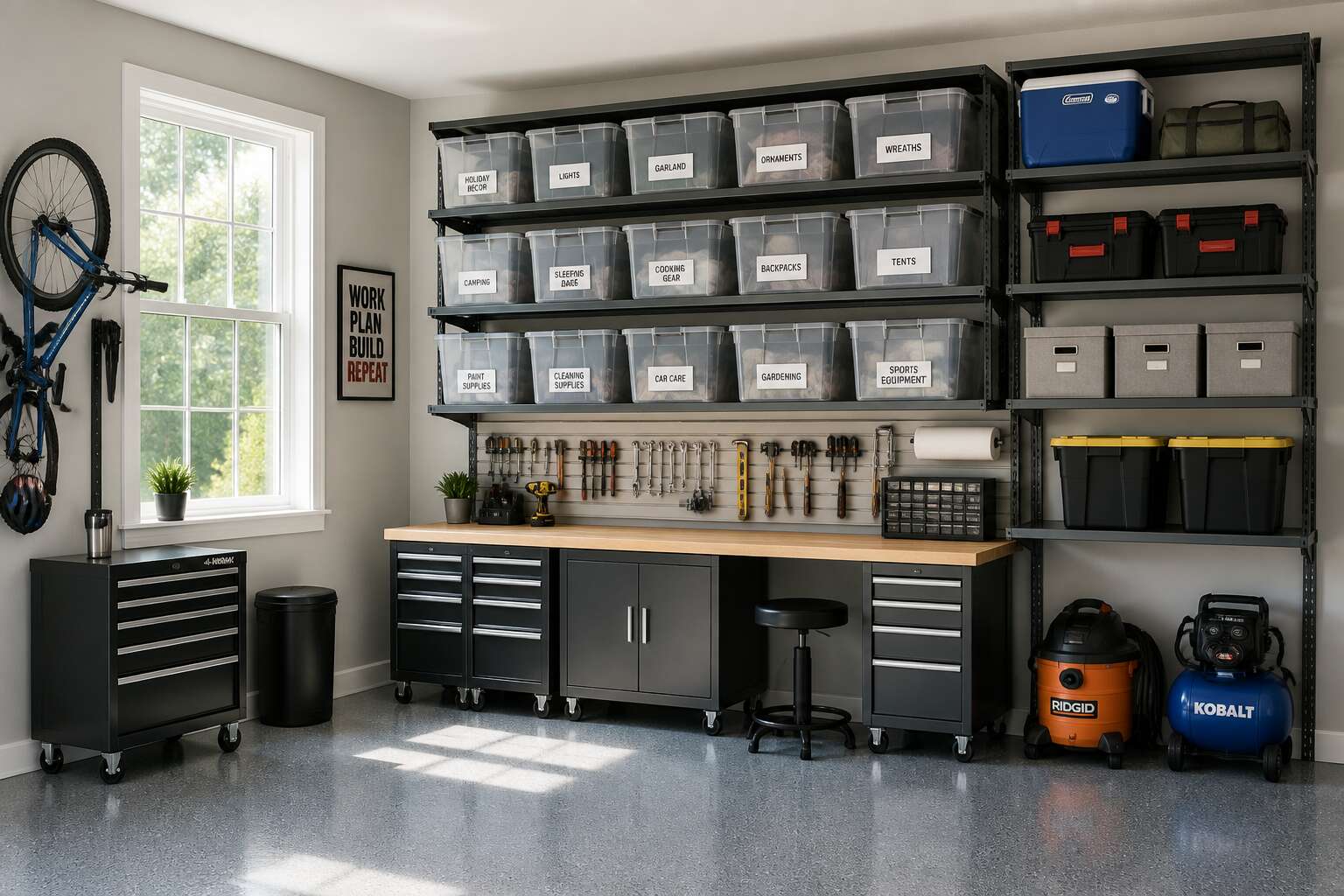
Clear storage containers only succeed when paired with a deliberate shelving plan. Without a system, transparency becomes clutter in plain sight. The container reveals the chaos inside. The shelving garage ideas that work best treat visibility as a practical tool, not a decorative feature.
Select containers that stack without bowing. Match the box size to the shelf depth. Overhanging bins waste space and create dead zones. Use identical containers for similar categories, so the shelf reads as one cohesive block rather than scattered shapes.
- Crates with hinged lids for lightweight seasonal decor
- Low profile boxes for flat items like wrapping paper
- Totes with reinforced corners for heavier tools
Assign each container a permanent shelf position before you fill it. The clear body shows the contents, while a simple marker on the shelf shows the address. This pairing of transparency and structure turns everyday shelving garage ideas into a system you can trust at a glance.
Maximizing Vertical Space
The average garage in South Africa has roughly 30 percent of its cubic volume unused above head height. That is the difference between a cluttered floor and a working space. Shelving garage ideas rarely succeed without a deliberate approach to verticality. Install racks to within arm’s reach of the ceiling, but keep the top shelf for items you touch twice a year.
Consider three rules for vertical organisation:
- Maintain clear sightlines from the doorway to the back wall.
- Store heavier loads between knee and shoulder height.
- Use pull down ladders only if you need daily access.
These shelving garage ideas multiply the usefulness of every upward metre. The structure of your shelving determines whether that space works for you or against you.
Establishing Dedicated Hobby and Equipment Zones
Your garage floor should never be a resting place for half-disassembled projects. Dedicated hobby zones reclaim that space. Allocate a corner for each activity: a workbench for woodworking, a wall rack for camping gear, a sealed cabinet for fishing tackle. These shelving garage ideas turn clutter into a functioning workshop.
Zone planning works best when you respect physical limits:
- Keep daily-use tools between knee and eye height.
- Place heavy loads on lower shelves, never overhead.
- Group items by activity, not by size.
Sketch your zones before buying a single bracket. Measure doorways, vehicle clearance, and power outlets. The most effective shelving garage ideas start on paper, not in a store. Match each zone to your real workflow, and the garage stops being a storage unit and starts being an extension of your home.
Installation Methods and Safety Tips
Understanding Weight Capacity and Anchoring
The best shelving garage ideas are worthless without proper installation. Every shelf has two limits: the per shelf weight and the total unit capacity. Go beyond either one and the structure fails.
Anchoring matters equally. In South African garages, walls are often brick or concrete. Use masonry anchors, not plastic plugs, for anything over 20 kilograms per shelf. Then consider the floor. Freestanding units need a base plate with four anchor bolts.
Check these points before loading!
- Tighten all bolts after the first week.
- Confirm the brackets are flush against the wall.
- Leave a 5 mm gap from the floor to allow for expansion and movement.
A correctly anchored unit holds steady through daily use. A loose one is a hazard with every rattle.
Using Proper Tools and Measuring Techniques
A spirit level and a stud finder should be in your hand before any bracket touches the wall. Measuring twice may feel tedious, but in a garage with uneven floors, it separates a straight installation from a misaligned mess. Mark your fixing points with a pencil, then drill pilot holes using a masonry bit matched to your anchor size.
Use a torque driver for bolts that secure heavy units. A handheld screwdriver will not deliver consistent tension across all fixings. For shelving garage ideas that involve multiple uprights, clamp a straight edge across the posts to confirm alignment before fully tightening. These installation methods apply to most shelving garage ideas, from freestanding frames to wall-mounted systems.
- Check the floor slope with a level before marking.
- Drill pilot holes 10 mm deeper than the anchor length.
- Use a socket wrench for M8 bolts, not an adjustable spanner.
Each fix relies on a clean hole. Dust from brick or concrete weakens grip, so blow out the hole before inserting the anchor.
Baby and Pet-Proofing Your Shelving Setup
If your garage doubles as a play zone or a pet patrol area, shelving garage ideas need a toddler-proof and terrier-proof master plan. Secure every unit to the wall, not just the heavy ones. A wobbly shelf is an invitation to curious climbers. For shelves below waist height, consider locking bins or door catches.
– Use corner guards on exposed uprights.
– Install anti-tip straps anchored into studs.
– Keep toxic chemicals on top shelves with childproof latches.
Pets can also trigger avalanches. Fasten loose items in containers and avoid open wire racks that snag paws. Check your fixings monthly for rust or movement. An anchored shelf is a safe shelf, whether your little one is human or furry.
Reinforcing and Adjusting Existing Units
Reinforcing an existing shelving unit starts with a thorough inspection. Look for bent uprights, cracked welds, or corroded bolts, especially in humid coastal garages. Tighten every connection with a torque wrench rather than guessing. Replace missing rivets with machine screws and lock nuts for a more durable hold.
Adjust shelf heights before you load new items. Most adjustable units use a simple pin or clip system, but these can wear after years of service. Swap in heavier gauge shelf clips for metal racks or reinforced brackets for wooden boards. This simple tweak extends the practical capacity of your shelving garage ideas without the cost of a new unit.
Consider adding a diagonal stabiliser bar to any tall frame. It reduces lateral sway and keeps stored goods aligned. If your shelves sit on uneven flooring, use shims under the feet rather than bending the frame. A level unit distributes force evenly across all joints.
For shelves carrying loose bolts or paint tins, add a plywood liner to the wire surface. It spreads point loads and prevents items from slipping through.




0 Comments