Drive-In Racking Systems Overview
Definition and core concept
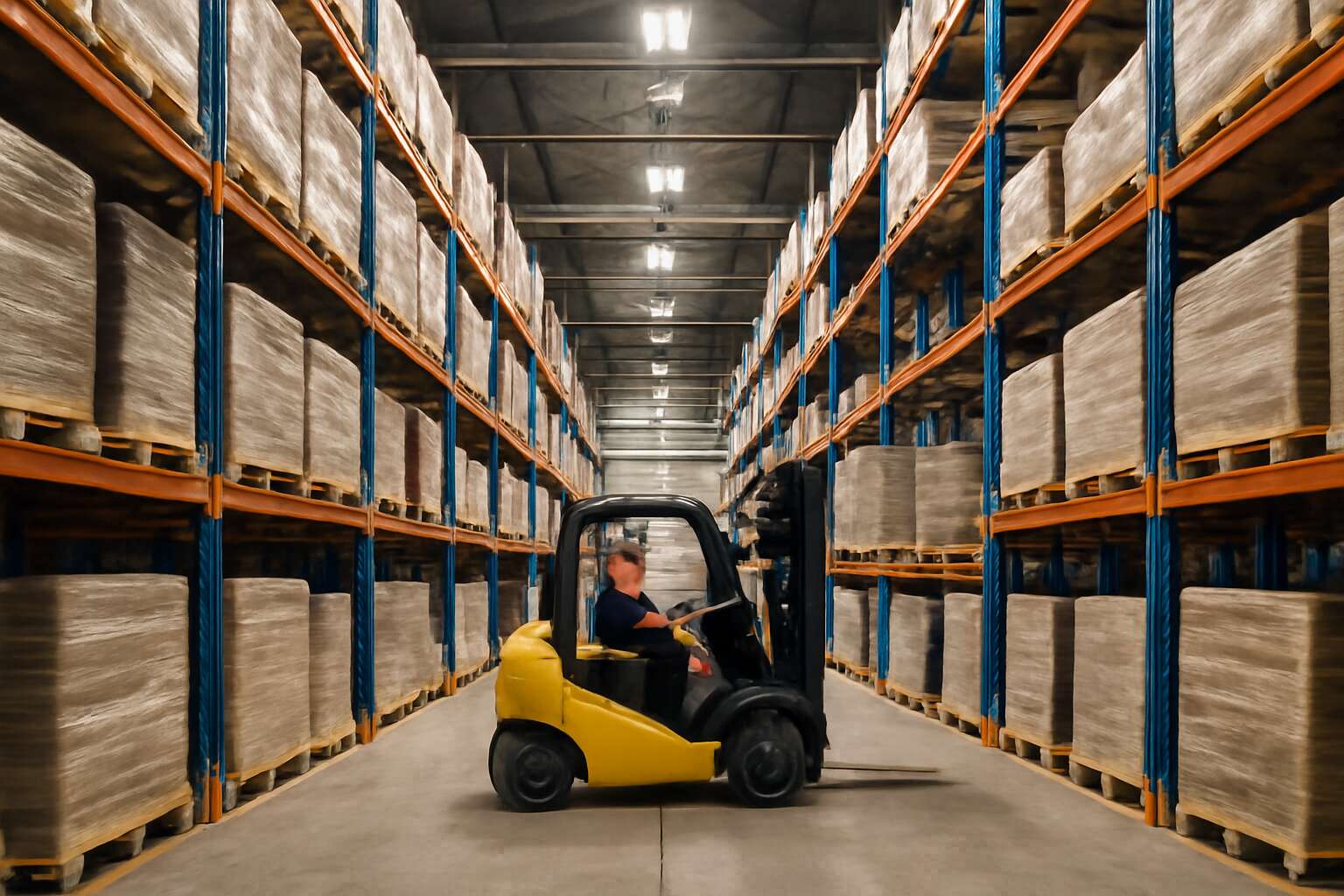
In a South African warehouse, space is the ultimate currency, and high-density storage is the answer to cramped aisles and rising costs. Readers often ask: what is a drive in racking system? It’s a high-density configuration where pallets are loaded and retrieved by forklifts along a continuous run of rails, forming a tunnel-like lane that stores goods directly on the bay floor. Think of it as a compact city block inside a warehouse.
Drive-in setups optimise footprint by concentrating storage in stacked lanes rather than spreading pallets across multiple aisles. Pallets are placed and retrieved in the same sequence, which boosts density but means stock rotation requires planning. This arrangement shines with uniform pallet sizes and predictable SKUs, a common pattern in batch storage environments.
Key components and operation
Space is the true currency in a South African warehouse, and density is king. Drive-in configurations carve corridors directly into the racking, letting forklifts glide along a continuous rail to load and retrieve pallets. Readers often ask: what is a drive in racking system? It’s a high-density setup where pallets rest on the bay floor, forming tunnel-like lanes that save footprint while keeping operations surprisingly smooth.
- Continuous rail runs that guide forklifts into a sealed storage lane
- Bay-floor pallet supports with robust uprights and end frames
- Clear entry and exit points with safety protections to manage traffic
During operation, pallets are placed and retrieved in the same sequence, demanding precise rotation planning. This makes drive-in racking ideal for uniform SKUs and batch storage, turning a warehouse floor into a compact city of goods.
Configurations and layouts
Space is the currency of a South African warehouse, and drive-in designs tighten the grip. For those asking what is a drive in racking system, the answer is a high-density layout where pallets rest on the bay floor and lanes dive into the rack, forming tunnel-like aisles. It converts cramped footprints into a compact city of goods—dense, efficient, and unexpectedly smooth to operate.
Configurations vary by footprint and SKU mix, and layouts adapt to throughput demands.
- Single-drive lanes that prioritize uniform SKUs
- Back-to-back bays for maximum pallet depth
- Hybrid drive-in sections that balance density with safer access
Key layout considerations include bay depth, aisle width, and the alignment of loading and retrieval points. Clear entry and exit routes, durable uprights, end frames, and safety protections help manage traffic and maintain rotation discipline.
Benefits and drawbacks
In South Africa’s bustling warehouses, density is king, and a well-implemented drive-in setup can boost storage density by up to 60%. But what is a drive in racking system? It’s a high-density layout that lets pallets rest on the bay floor and lanes dive into the rack, forming tunnel-like aisles that squeeze space without slowing the flow.
Overview: The design trades ease of access for maximum storage, thriving in consistent product lines and tight rotation. It reduces the footprint per pallet but can slow retrieval times and demands strict safety discipline.
- Benefits: exceptional space efficiency; fewer aisles to traverse; straightforward inbound handling.
- Drawbacks: limited accessibility for mixed SKUs; longer picking cycles; higher capital and maintenance for safety and equipment.
Industries and typical applications
In South Africa’s high-stakes warehouses, space is currency. If you’re asking what is a drive in racking system, think tunnel-like lanes that swallow pallets as they rest on the bay floor. The design trades ease of access for maximum storage, turning corridors into stacked avenues that push density higher without slowing throughput.
Industries and typical applications across South Africa employ drive-in racking to stabilize predictability and volume. It finds its home where SKUs are consistent, turnovers steady, and margins hinge on space efficiency.
- Bulk pallet storage for stable SKUs
- Seasonal inventory with predictable turnover
In the South African context, the approach shines in large distribution centers where vehicle access and inbound/outbound flows must stay lean, yet space is premium. The tailored design supports long-term storage strategies while remaining vigilant about safety protocols and maintenance.
Key Components and Configuration Options
Frames, uprights, and connectors
Understanding what is a drive in racking system reveals a framework where space becomes strategy. In bustling South African warehouses, inches become meters of throughput when frames, uprights, and connectors align with purpose.
Frames provide the outer skeleton; their depth and width determine pallet footprint and aisle access. Uprights rise as carriers of height, with perforations or slots for adjustable cross members. Connectors—bolted, clipped, or clipped-in—link frames to uprights, enabling rapid reconfiguration and robust stability, a practical illustration of what is a drive in racking system.
- Frame depth, height, and material options
- Upright spacing, load ratings, and back-to-back configurations
- Connector types that balance speed of assembly with rigidity
Configuring these elements tailors drive-in racks to product mix, inbound tempo, and safety standards in local markets; the result is a tailored lane that supports efficient, cycle-driven operations.
Pallet and load compatibility
In South Africa’s bustling warehouses, space is currency and velocity is value. what is a drive in racking system sits at that intersection of density and cadence, turning pallets into fluent traffic. It channels goods along a single spine, inviting speed to be measured by throughput rather than by aisles of width, a harmony forged in steel and intention.
Key to its charm is pallet and load compatibility, where run depth and footprint converse in harmony. Pallets must share a footprint that fits the lane and supports safe, steady retrieval, letting each glide become a measured breath of efficiency.
- Standard single-entry pallets
- Double-deep pallets for density
- Non-standard pallets requiring tailored handling
Configured with care, the system yields a tailored lane that respects safety, speed, and the rhythms of South African supply chains.
Single-entry to multi-entry configurations
Drive-in systems transform warehouses into high-density, velocity-driven spaces. In South African logistics, space is currency and throughput is value—pallet counts can rise by up to 40% when density meets cadence.
To answer what is a drive in racking system beyond the buzz, the key is its backbone: a continuous guide rail with one or more access points that let forklifts place and pull pallets along a fixed line. For clarity, consider single-entry to multi-entry configurations.
- Single-entry configurations—one pallet lane, simple access, ideal for uniform loads
- Double-deep configurations—two pallets deep for density without extra aisles
- Multi-entry configurations—several lanes sharing a central spine for very high throughput
Configured with care, the system respects safety, speed, and the rhythms of South African supply chains, offering a tailored balance between capacity and maneuverability.
Aisle design and forklift access
Warehouses in South Africa chase centimetres and cycle times; density is the new king. In this climate, drive-in racking systems transform space into velocity, letting pallets stack along a continuous path. So, what is a drive in racking system? It’s built around a continuous guide rail with access points that let forklifts tuck pallets in and pull them out along a fixed line, slashing aisle waste while boosting throughput — up to 40% gains when density meets cadence, a boon for South African distribution networks.
Key components and configuration options include:
- Continuous guide rails that define the path and keep pallets aligned
- Access points and entry/exit lanes at strategic spots
- Uprights, connectors, and pallet supports that transfer load safely
- Safety features and load retention to protect personnel and product
Aisle design and forklift access in South Africa hinge on turning radii and lane width, balancing density with maneuverability and safety.
Load and storage considerations
So, what is a drive in racking system? In concise terms, it’s a dense, fixed-line storage path that lets forklifts pull pallets along a continuous lane. The core idea is mindful load and storage considerations: weight distribution, pallet footprints, and entry/exit alignment that maximize space without sacrificing safety.
Load and storage considerations hinge on how goods behave along the incline of pallets. Factors include pallet tolerance, load uniformity, and environmental effects that shift weight over time. The following elements help planners balance density with reliability:
- Pallet dimensions and tolerances that fit the rails
- Weight distribution across the drive-in lane to prevent uneven sag
- Environmental conditions and their impact on packaging integrity
Configuration options then tailor capacity: choosing the number of access points, lane width, and whether to run single or multi-entry configurations. This orchestration yields predictable cadence and throughput for South African distribution networks.
Benefits, Limitations, and Use Cases
Storage density and space utilization
A across crowded warehouses, efficiency is a quiet thriller. In South Africa, facilities report storage density increases of up to 60% with this approach. The question what is a drive in racking system can guide your choice. It’s a high-density solution where pallets sit on rails in a long, shared lane, and forklifts enter to load and retrieve from the same location. Fewer aisles, more usable floor space, tighter inventory control.
Benefits include:
- Higher storage density per square meter
- Space utilization via shared lanes
- Lower capital per stored unit
Limitations require planning: FIFO access can be limited, loading speed may drop, and routine maintenance becomes more important to ensure safety.
Use cases and the impact on storage density and space utilization include:
- Bulk storage of homogeneous SKUs
- Cold or climate-controlled environments
- High-density layouts for regional hubs
Inventory control and access patterns
Benefits of a drive in racking system extend beyond floor savings. In a crowded warehouse landscape, it delivers higher storage density per square meter and tighter inventory control through shared lanes. what is a drive in racking system reveals a theatre of space where pallets sit along a single axis, reducing motion and lowering capital per stored unit.
Limitations require careful planning: FIFO access can be constrained, loading speed may drop, and routine maintenance becomes essential to safety and reliability in South Africa’s bustling distribution networks.
Use cases and inventory control patterns for drive-in racking emphasize a disciplined flow of goods. Bulk storage of homogeneous SKUs, climate-controlled environments, and regional hubs benefit from predictable access patterns that minimize unnecessary travel and maximize floor space.
- Centralized pallet retrieval along a single lane
- Predictable replenishment and reduced travel time
- Auditable stock records with clear FIFO flow
Cost, ROI, and total ownership
In South Africa’s busy warehouses, space is currency and density is king. For those asking what is a drive in racking system, the answer is a design that concentrates pallets along a single axis, turning floor area into a theatre of storage. Benefits come fast: higher storage density per square meter and tighter inventory control through shared lanes, so you squeeze more into the same footprint without expanding the building.
Limitations require careful planning: FIFO access can be constrained, loading speed may drop, and routine maintenance becomes essential to safety and reliability in South Africa’s bustling distribution networks.
Use cases and total ownership considerations follow a disciplined flow of goods: bulk storage of homogeneous SKUs, climate-controlled environments, and regional hubs benefit from predictable access patterns that minimize travel and maximize floor space. Cost and ROI balance upfront CAPEX with long-term savings, while total ownership covers maintenance, warranties, and risk management across a multi-site network.
- Centralized pallet retrieval along a single lane
- Predictable replenishment and reduced travel time
- Auditable stock records with clear FIFO flow
Industry-specific use cases
Density is king in South Africa’s busy warehouses. For those asking what is a drive in racking system, this design concentrates pallets along a single axis, turning floor space into a storage theatre. Benefits come fast: higher storage density per square metre and tighter inventory control through shared lanes, squeezing more into the same footprint.
Limitations demand careful planning: FIFO access can be constrained, loading speed may drop, and routine maintenance becomes essential to safety and reliability in South Africa’s networks.
Use cases and total ownership follow a disciplined flow of goods: bulk storage of homogeneous SKUs, climate-controlled environments, and regional hubs benefit from predictable access patterns that minimize travel and maximise floor space. Cost and ROI balance upfront CAPEX with long-term savings, while total ownership covers maintenance, warranties, and risk across a multi-site network.
- Bulk storage of homogeneous SKUs
- Climate-controlled environments
- Regional hubs with predictable access
Potential limitations and trade-offs
Benefits: what is a drive in racking system? This design concentrates pallets along a single axis, turning floor space into a storage theatre. You gain higher density per square metre and tighter inventory control through shared lanes—crucial when SA warehouses push every cubic metre to the limit. Fewer forklifts zig-zagging between aisles also means a calmer, steadier rhythm for bulk loads.
Limitations: FIFO access is constrained, loading speed can drop, and ongoing maintenance becomes non-negotiable in busy networks. Front-entry access means back pallets are tougher to reach, and small variances in pallet size or weight can throttle throughput when demand shifts.
Use cases: Suited to bulk, uniform pallets and environments where space trumps fast picking. It also works for climate-controlled spaces and regional hubs with predictable inbound and outbound flows.
- Bulk, uniform pallets
- Stable climate-controlled environments
- Regional hubs with predictable flows
Design, Installation, and Safety Considerations
Site assessment and space planning
In warehouses where space is a currency, design becomes a narrative of efficiency and grace. Understanding what is a drive in racking system begins there, as a high-density framework that deepens storage while preserving essential access and safety.
Site assessment and space planning guide every beam and bearing: floor flatness, bay widths, forklift routes, and climate quirks South Africa presents. Installation follows a careful script, aligning uprights, rails, and pallets to endure daily use.
- Aisle width and reach-vehicle clearance
- Floor loading and joints
- Corrosion resistance and inspection cadence
Safety considerations rise when loading protocols and maintenance routines become habit; clear pathways and trained operators knit a dependable system.
System selection criteria
In warehouses where space is currency, design must balance density with access. what is a drive in racking system? It’s a high-density framework that stores pallets along single drive lanes, yet keeps entry points clear for safety and fast retrieval. Size, compatibility, and stability guide these choices.
Installation follows that design logic: precise upright alignment, proper rail seating, and dependable pallet support. In South Africa, floor flatness and environmental factors shape tolerances, so the frame endures daily handling without compromise.
Safety considerations anchor every decision in system selection criteria. Clear pathways, trained operators, and routine inspections prevent disruption.
- Load compatibility and stress limits
- Maintenance cadence and corrosion resistance
- Adaptability to inventory changes and seasonal peaks
Installation steps and timelines
Design for a drive-in racking system prioritises density without sacrificing access. A balanced setup stores pallets along single drive lanes, while entry points stay clear for safety and rapid retrieval. In South Africa, floor flatness and environmental factors shape tolerances, guiding frame rigidity. what is a drive in racking system, it’s a high-density framework that stores pallets along dedicated aisles, yet keeps paths open for operators and forklifts.
Installation follows that design logic with precision. The work is staged to minimize disruption and preserve access during setup. Steps typically unfold from site survey and floor preparation to upright alignment, rail seating, pallet testing, and final inspection, over a few days in a mid-sized facility.
Safety considerations anchor every decision. Clear pathways, trained operators, and routine inspections prevent disruption. Maintenance cadence and corrosion resistance remain core as the system adapts to inventory changes and seasonal peaks while preserving safe access.
Safety compliance and accident prevention
In warehouses worldwide, density-minded systems unlock up to 60% more pallet storage per square meter. The question “what is a drive in racking system” sits at the core, guiding schemes that maximize pallets per bay while leaving operators room to breathe and move with confidence. In South Africa, floor flatness and humidity patterns steer tolerances and frame rigidity.
Installation follows that quiet philosophy with measured tempo. Work is staged to preserve access; the layout informs upright alignment and rail seating, while on-site testing guarantees smooth pallet entry along the lanes. The rhythm slows disruptions in mid-sized facilities, even as the structure rises.
Safety considerations anchor every decision. Compliance, training, and routine inspections keep the space safe as inventory flows with seasons and spikes. Operators understand their paths, equipment checks become ritual, and the system remains resilient under changing loads.
- Clear pathways and signage
- Regular operator training
- Periodic inspection schedules
Inspection, maintenance, and lifecycle management
For understanding what is a drive in racking system, consider this: it’s a high-density solution built around uninterrupted lanes that swallow pallets from a single entry. Design centers on stable load paths, precise uprights, and controlled clearances, with local floor conditions guiding rigidity in South Africa and interaction with concrete slabs. The result is density without chaos, a storage corridor that breathes even as pallets pile up.
Installation follows a measured tempo: staged deliveries, aligned uprights, and tuned rail seating. On-site testing confirms smooth pallet entry and consistent lane alignment before the first fork penetrates the bay.
- Alignment and bolt torque checks
- Rail seating and plumb verification
- Clear signage and access planning
Safety considerations, inspection, maintenance, and lifecycle management keep the system resilient. Regular audits, corrosion monitoring, and fastener checks extend life, while refurbishment or replacement plans protect throughput through peak demand and seasonal surges.
Operation, Optimization, and Modernization
Access optimization and FIFO/LIFO patterns
Operation: What is a drive in racking system? It’s a storage configuration where pallets rest on parallel rails, forming deep, single-entry lanes that forklifts drive into to load or retrieve goods. In operation, items are stored by depth, maximizing density while preserving stable handling.
Optimization: Access patterns balance density with turnover. Access optimization uses FIFO and LIFO patterns to match product flow and shelf life.
- FIFO: first-in, first-out for perishable items.
- LIFO: last-in, first-out for high-turn items.
These patterns affect rack wear and maintenance, so design choices should honor throughput alongside stock rotation.
Modernization: Upgrading rails, sensors, and control systems keeps the system efficient and safe. A quiet hum of modernization guides pallets to their destinations, while SA warehouses benefit from improved maintenance, visibility, and compliance—preserving the compact appeal that makes drive-in racking so enduring.
Integration with automation and software
In South Africa’s bustling warehouses, what is a drive in racking system becomes clear at a glance: pallets rest on parallel rails inside deep, single-entry lanes that forklifts drive in to load or retrieve goods. The design packs density without sacrificing stability, a quiet testament to practical mastery when space is precious and weathered hands keep the operation moving.
Optimization turns density into reliable access. It balances high shelf density with turnover by applying FIFO for perishables and LIFO for fast-moving items. Automation and software monitor flow, alerting when rotation is off and keeping stock movements smooth.
- Real-time inventory tracking
- Automated stock rotation insights
- Condition-based maintenance prompts
Modernization brings rails, sensors, and control systems into a seamless dance, guided by automation and software. For South African facilities, this upgrade lifts maintenance, visibility, and compliance, preserving the compact appeal that makes drive-in racking endure while expanding safety and throughput.
Maintenance and reliability improvements
Space is money in South African warehouses, and what is a drive in racking system answers that question in one line—compact, high-density storage with deep, single-entry lanes that forklifts drive in to load or retrieve. Operation stays stable and efficient even on tight shifts.
Optimization turns density into dependable access. It balances shelf density with turnover by applying FIFO for perishables and LIFO for fast-moving items, guided by data that highlights rotation gaps and efficiency opportunities, keeping stock flow smooth.
Modernization brings rails, sensors, and control systems into a seamless loop. For South African facilities, this upgrade lifts maintenance, visibility, and safety, while predictive diagnostics shrink downtime and extend component life, boosting reliability and throughput in demanding environments.
Cost of energy and equipment efficiency
Space is money in South Africa’s busy warehouses, and a drive-in racking system can trim travel time and boost throughput. In this setup, what is a drive in racking system? It’s compact, high-density storage with deep, single-entry lanes that forklifts drive into to load or retrieve. Operations stay stable even on tight shifts.
Optimization turns density into dependable access. It balances shelf density with turnover by applying FIFO for perishables and LIFO for fast-moving items, guided by data that highlights rotation gaps and efficiency opportunities, keeping stock flow smooth.
Modernization brings rails, sensors, and control into a seamless loop. For South African facilities, this upgrade lifts maintenance, visibility, and safety, while predictive diagnostics shrink downtime and extend component life, boosting reliability and throughput in demanding environments. From an energy and equipment-efficiency perspective, smarter control trims idle time and motor wear, lowering operating costs over the system’s life.
Case studies and success stories
Operation in South Africa’s bustling warehouses rewards the swift with revenue. Each extra metre saved translates to minutes of uptime and measurable throughput. The question “what is a drive in racking system” is answered: it’s compact, high-density storage with deep, single-entry lanes forklifts drive into to load or retrieve, keeping operations stable even on tight shifts.
Optimization turns density into dependable access. It balances shelf density with turnover, applying FIFO for perishables and LIFO for fast movers, guided by data that reveals rotation gaps and efficiency opportunities, ensuring stock flow remains smooth even on peak shifts.
Modernization brings rails, sensors, and smart control into a seamless loop. In SA facilities, this upgrade lifts maintenance, visibility, and safety, while predictive diagnostics shrink downtime and extend component life. Case studies and success stories demonstrate how this translates to reliability and throughput in demanding environments.



0 Comments