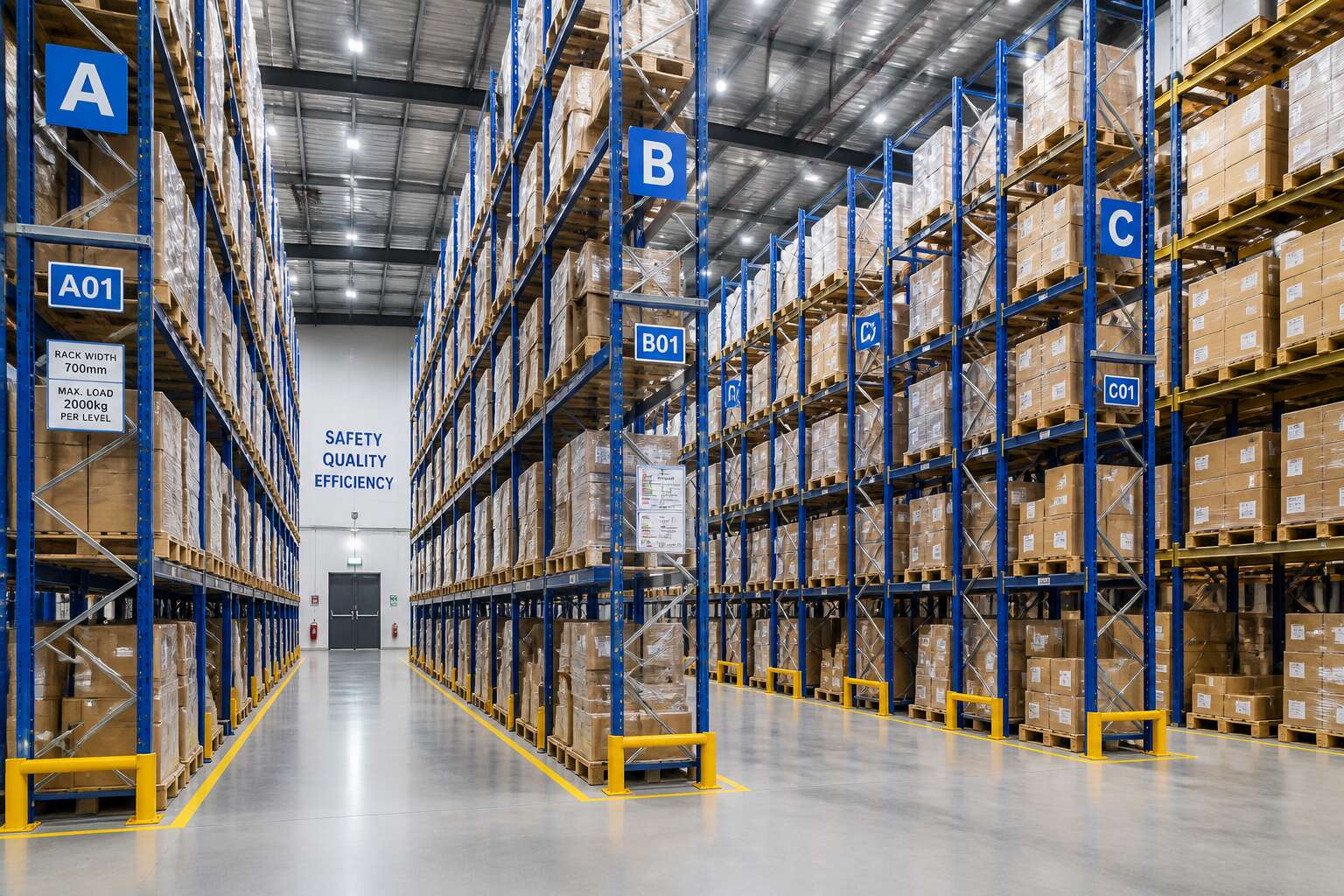
Understanding the Depth Advantage
What 700mm Depth Means in Practice
Depth is the silent factor in warehouse planning. Most buyers fixate on width, yet a racking 700mm wide installation lives or dies by its depth. A shallow spec might handle light cartons, but a deeper beam gives you real flexibility for South African stock.
The practical gain is simple. With 700mm width and a depth profile of 600mm to 800mm, you can store goods that would otherwise demand expensive, oversized systems. That means more rows per aisle and better cubic utilisation. You can also service it with a standard pallet jack or a narrow counterbalance truck without reconfiguring your layout.
Here is what that depth actually accommodates:
– Totes and bins up to 600mm deep
– Long steel sections laid flat
– Retail cartons stacked two or three deep
The result is a system that works as hard as your floor space. Racking 700mm wide with the right depth gives you density without sacrificing access, which matters when every square metre of a Durban or Johannesburg warehouse carries a cost.
Comparing to Wider Alternatives
Wider alternatives tempt you with extra space that often stays unused. A racking 700mm wide system with proper depth outperforms a 1200mm unit because depth, not width, determines how many SKUs you can stage per bay.
Think about the floor footprint. Wider beams push aisles apart, forcing longer travel times or a fleet of articulated trucks. Depth lets you pack rows tighter while keeping access. Consider these gains:
- More pallet positions per square metre
- Smaller turning circles for handling equipment
- Lower steel costs per load
The depth advantage shows up in pick rates and fuel costs. South African warehouses rarely suffer from a lack of width; they suffer from wasted depth. So before you choose a wider profile, ask what a 700mm rack with 800mm depth can do. It often does more, with less.
Impact on Aisle Width and Maneuverability
The warehouse is a place of shadows and hard angles. The distance between racks is a gap that every truck must navigate. A racking 700mm wide system, with the right depth, changes that gap. When the pallet is held farther back, the protruding edge of the load no longer determines the turning swing. I have watched a reach truck operate in a 2.8 metre aisle where 3.4 metres was once required. The only change was the depth of the rack!
- The turning circle shrinks without equipment changes.
- The aisle width reduces, freeing floor for staging.
- The travel path becomes shorter for every journey.
Its depth reduces the aisle width requirement.
Structural Design and Engineering
Material Grades and Thickness
Racking 700mm wide systems hide their structural complexity behind simple frames. The real engineering depends on material grades and thickness. South African engineers often specify S355JR steel for uprights because its yield strength exceeds that of S235JR, which works for lighter storage demands. The gauge of the steel, not the rack’s depth, governs how much dynamic load the frame absorbs.
- Upright frames: 2.5mm to 3.0mm thick S355JR
- Beams: 1.8mm to 2.0mm thick S235JR
- Bracing bars: 1.5mm thick, cold rolled
Lateral forces from pallet handling and seismic activity concentrate on welds and bolt connections. This configuration demands tighter tolerances on column straightness than wider layouts. Reduced depth changes the stress distribution, but it never lowers the required steel quality. Proper engineering balances every element.
Beam and Upright Connection Types
Engineers rarely discuss the humble clip, yet the beam to upright connection carries every kilonewton a pallet demands. The reduced column footprint forces bolts and rivets to work harder than wider layouts demand.
Three connections dominate South African installations. The first is the integral locking pin, pressed into the beam end. The second is the bolt through plate, used where seismic ratings apply. The third is the retrospective weld, common in cold stores.
- Locking pin connections endure rapid handling cycles
- Bolted plates allow site adjustment within tolerances
- Welded cleats transfer shear without loosening
Each connection type shifts the stress path through the frame. Selecting the wrong one in racking 700mm wide risks column twist that the narrow upright cannot absorb.
Reinforcement for High-Density Storage
In dense storage, the narrow footprint of racking 700mm wide creates a column that must resist far more than vertical gravity. The engineering challenge is not simply holding weight but managing the lateral forces that emerge during dynamic handling. A 700mm deep beam often supports loads where the centre of gravity sits almost directly above the upright. This proximity demands precise structural reinforcement, as even a minor shift in load distribution can amplify stress.
The compact geometry changes how forces travel through the frame. With a larger system, the wide base absorbs shock and dissipates energy naturally. In this system, the frame must be reinforced to handle torsion and impact simultaneously. High-density storage means tighter clearances, and a forklift strike that might graze a wider column can deliver a brutal, direct hit to a 700mm upright.
To preserve structural integrity, engineers focus on three areas of reinforcement:
– Column bracing that is welded rather than bolted, ensuring a continuous load path.
– Base plates with additional gussets to distribute the point load across the concrete floor.
– Doubled-up upright sections at the aisle ends where impact risk is highest.
The real tension appears in drive-in installations, where the absence of beams means the uprights alone resist the entire stored load. Here, the 700mm width forces a reliance on full-height bracing and cold-formed steel sections with higher yield strengths. Traditional open-back columns may buckle where a narrower, closed-back profile would hold.
Load deflection also behaves differently. A 700mm upright is stiffer, but this stiffness transfers shock rather than absorbing it. The result is that every kilonewton from a pallet, every vibration from a forklift, travels directly into the floor anchors. Shear forces concentrate at the base, requiring anchors set deeper and cast with greater precision. A shorter column footprint means less surface area for the concrete to grip.
Floor flatness becomes structural, not cosmetic. In standard racking, minor undulation is tolerated. In racking 700mm wide, a floor variation of a few millimetres can shift the load path entirely. The upright, fixed in its narrow plane, has no room to compensate. Shims can address initial levelling, but they do little to manage the constant micro-movements of handling cycles.
This is where the design philosophy shifts from optimal to sacrificial. The 700mm system is engineered to fail predictably, to show deformation signs before a catastrophic collapse. Bolt holes are precisely punched to create weak points that bend under overload, giving operators a visible warning. The reinforcement is thus not about making the system indestructible but about making its limits legible. In high-density storage, where every millimetre is occupied, this readability is the true safety feature. The structure speaks in groans and flexes, and the engineer listens. The warehouse floor becomes the final judge.
Considerations for Floor Loading
Floor loading is the silent partner in any racking 700mm wide installation. The uprights concentrate weight into a narrow footprint, so the concrete slab must accept point loads that would barely register under a wider system. Static capacity tells only part of the story. The repetitive impact of forklift wheels, sway loads, and pallet placement creates fatigue that standard industrial flooring often is not designed for.
Engineers specify these systems based on the load transfer path:
- Upright base plates transmit vertical force to the slab.
- The slab distributes that force through its depth.
- The subfloor and soil absorb the eventual residual.
A floor that meets the compressive strength requirement on paper can still fail through flexing or uneven settlement. Racking 700mm wide demands a flat, dense slab with continuous reinforcement. Joints and crack lines are the weak points, shifting load paths unpredictably. Design calculations must include the actual floor profile, not just the catalogue rating.
Installation and Site Preparation
Measuring and Marking the Layout
The true test of any installation begins with the layout. A racking 700mm wide system only performs when the first chalk line lands true. Skip this phase and you will chase squareness across every subsequent row. I have watched crews waste an entire day fighting misaligned bases because someone trusted a single wall measurement. For South African warehouses, where concrete slabs shift imperceptibly over decades, the reference point must never be assumed.
Mark from a committed datum. Measure each bay, then mark the vertical face of each upright. Perform these three checks in order:
- Confirm the aisle width across the racking.
- Verify that opposing lines remain parallel.
- Use a theodolite for long runs.
Once scribed, leave the marks overnight. Temperature changes and afternoon shadows will reveal errors that a bright light hides. A racking 700mm wide installation lives or dies on this preparation.
Anchoring Methods for Different Floors
Anchoring a racking 700mm wide system begins with the floor slab. A 150mm reinforced concrete slab will hold expansion anchors securely. A thin screed over hollow fill will not. In South African warehouses, the difference appears as cracked epoxy and tilted uprights within the first year.
The floor type determines the anchor selection. For sound, unreinforced concrete, use mechanical expansion anchors. For aged slabs with micro-cracks, chemical anchors outperform mechanical options. For steel decks with a concrete topping, the calculation changes entirely. Test a pull-out before committing to a pattern.
- Check the slab thickness before ordering anchors
- Inspect for existing cracks and repairs
- Confirm the concrete compressive strength
Anchor spacing matters more than anchor size. A racking 700mm wide upright needs its baseplate fully engaged. Torque each anchor to spec and re-torque after a week. The slab carries the load; the anchor holds position.
Sequencing the Assembly Process
Sequencing the assembly of a racking 700mm wide system begins with a quiet audit of the floor and the components. We stage every upright and beam in its destined bay, then walk the line with a spirit level and a tape measure. The first upright rises, but it needs a temporary brace while the second upright takes its place beside it.
- Set the first upright on the marked position.
- Raise the second upright and connect the base beam.
- Verify plumb with the level before any final torque.
Beams lock into place with a satisfying click, and the frame becomes rigid. We work from the bottom up, never skipping a bolt. A racking 700mm wide assembly rewards patience; a rushed fit produces a permanent sway. Check diagonal alignment after every third bay. The process is deliberate and methodical, and the steel holds its geometry.
Integrating with Bracing and Back Panels
There is a quiet art to preparing a site for a racking 700mm wide installation. The floor must be swept, not merely for tidiness, but because a stray bolt or a dust pile will throw off the base plates. We check the overhead clearance before anything else. A racking 700mm wide system can slide into place with surprising ease, but only if the site allows for the swing of a ladder and the reach of a gloved hand.
Bracing is where the character of the installation shows itself. We attach the back panels first, before the shelves, because reaching through a loaded frame is a chore no one enjoys.
1. Fix the bottom brace to the rear uprights.
2. Slide the back panel into its guides.
3. Secure the top brace to lock the panel in place.
The steel then stands with a taut, drum-like rigidity. Site preparation and bracing work together. One keeps the footing honest, the other keeps the frame from swaying under an uneven load. It is a partnership of patience and torque, and it rewards the careful installer.
Post-Installation Adjustments
Post-installation adjustments begin with a walk along every aisle. The racking 700mm wide structure may look square from a distance, but a spirit level reveals the truth. We check each upright for plumb; a one degree lean multiplies under load. Then we revisit the anchor points. A torque wrench rechecks every bolt and expansion shield, as ground settlement or a skipped step shows up here.
- Measure diagonal distances on each bay.
- Inspect beam locks for full engagement.
- Confirm shelf levels against the laser line.
Only after these passes do we load the system. Even then, we return after a week of use to retighten and recheck, because steel and concrete settle at different rates.
Safety Protocols and Compliance
Industry Standards and Certifications
Racking 700mm wide demands rigorous safety protocols. In South Africa, the Occupational Health and Safety Act requires regular inspections and load testing. Without those, you risk equipment failure and injury.
Industry standards and certifications provide a baseline. SANS accreditation, along with EN 15512 compliance, signals that your racking meets accepted benchmarks.
A typical compliance review checks:
– Audit intervals determined by a certified inspector
– Load capacity signage on every beam level
– A functional damage reporting system
These elements define legal and operational safety for your warehouse.
Seismic and Impact Protection
A sobering statistic from the Occupational Health and Safety Act compliance reports suggests that almost 40% of warehouse racking collapses are precipitated by impact damage rather than overloading. This is where seismic and impact protection becomes a critical layer you cannot ignore.
The physics of a racking 700mm wide structure under lateral force is unforgiving. In South Africa, seismic activity in the Western Cape and Witwatersrand basin requires adherence to SANS 10160 standards. That standard dictates more than just the steel’s yield strength; it governs the entire structural response to ground motion.
For seismic resilience, the anchoring method and baseplate design are paramount. A racking 700mm wide system with tall uprights is vulnerable to toppling if the base is not engineered to absorb that kinetic energy. You must verify the anchor bolt pattern and the shim arrangement are rated for the specific seismic zone, not just general storage loads.
Impact protection, however, is about the daily reality of forklift operations. A single collision at 8 km/h can compromise the upright’s integrity without a visible dent. The key is to install sacrificial elements that absorb the shock:
– Steel column guards wrapped around the base of every main upright
– Reinforced end-of-aisle frames designed to crumple without transferring stress to the joints
– Bollards at high-traffic intersections with a minimum embedment depth of 300mm
Proper pallet positioning also plays a role in stability. A misaligned pallet on a racking 700mm wide beam creates a stress concentration point that amplifies impact forces. The inspection checklist should always include a visual check for these weak points, ensuring the damage reporting system catches issues before they escalate into structural failures.
Routine Inspection and Load Testing
Compliance is a continuous relationship with the structure, not a single event. Routine inspection of a racking 700mm wide installation should follow a documented schedule that matches the operational intensity of the facility. In South Africa, the Occupational Health and Safety Act requires the user to maintain the racking in a safe condition, and that duty extends past reactive repairs.
Load testing represents the empirical proof of structural integrity. A racking 700mm wide system should undergo a full load test at commissioning and after any significant modification. The test protocol should verify:
– Deflection under rated load
– Alignment of uprights and beams
– Integrity of anchor fixings
Testing records must be retained for audit purposes. Inspectors will ask for them, and they provide the forensic trail that demonstrates diligence. Regularity is the defining factor. A racking 700mm wide that is inspected monthly and tested annually will outperform one that is only checked when something visibly fails.
Employee Training and Signage
It is a quiet moment when a racking 700mm wide system fails. There is no scream of metal; there is only the sudden surrender of a beam under load. Safety protocols exist to prevent that silence. In South Africa, the Occupational Health and Safety Act places the responsibility squarely on the user, and that responsibility cannot be delegated to a third-party inspector. Employee training must be a continuous exercise, not a box-ticking induction on the first day.
Signage is the first line of defence that nobody notices until it is missing. A racking 700mm wide bay without a visible load rating is a mystery that could cost a worker their livelihood. Labels should state the maximum permissible load, the correct beam placement, and the consequences of overloading. The human brain is fallible; a bold, legible sign is not. This is where the structure speaks to the people who serve it.
Audits should verify the following discipline:
- Every employee has signed off on current training modules
- Signs are attached at eye level on every second upright
- Damaged or faded labels are replaced within 48 hours
The racking 700mm wide will hold if the people around it hold themselves to the same standard.
Fall Protection for Higher Levels
Standing on the third level of a racking 700mm wide structure changes perspective. The ground looks further away than the drawings suggest. Fall protection is a legal obligation, not an accessory. It separates a routine shift from an injury report filed with the Compensation Commissioner.
Higher levels demand anchor points certified to hold the dynamic load of a falling worker, roughly 100 kilograms in motion. Lanyards require inspection for cuts, chemical exposure, and stretched webbing. South African law leaves no room for guesswork at height.
Fall protection compliance covers:
- Anchorage points rated and tested annually by a competent person
- Rescue equipment capable of lowering a suspended worker
- Tool lanyards to stop dropped objects from reaching the floor
The structure behind the racking holds pallets, not people. Safety equipment is what carries a worker who slips. No racking system changes that.
Correcting Common Safety Violations
Compliance audits often expose the same errors. Workers lean ladders against racking 700mm wide instead of using the designated access equipment. Loads overhang beams because the pallet dimensions seemed close enough. Each violation seems minor until it becomes a statistic.
The common thread is routine. A worker who has passed the same bay a thousand times stops seeing the missing safety pin or the bent bracket. Correction requires more than a checklist. It demands someone who walks the floor with fresh eyes.
Specific violations require specific responses:
- Loads that obscure aisle signage must be repositioned immediately
- Beams with visible impact damage should be tagged out until assessed
- Safety gates that swing into the aisle create a tripping hazard and need adjustment
Warehouse managers who document every correction create a culture where the racking 700mm wide stays compliant because the details stay visible.
Maximizing Long-Term Value
Protecting Against Corrosion
Corrosion does not announce itself with a crash. It arrives quietly, rust blooming along beam ends and upright bases until the load capacity of a racking 700mm wide system is no longer guaranteed. In South Africa, the combination of coastal salt air and industrial atmospheres accelerates this decay.
Protection begins with the metal itself. Hot-dip galvanizing creates a sacrificial layer that withstands scratches and chips far longer than painted finishes alone. Powder coating offers another barrier, though any breach exposes the steel beneath.
Inspect the touchpoints where moisture collects on your racking 700mm wide. Pay attention to:
- Bolts and connector brackets
- Floor plates and anchor points
- The lower 300mm of each upright
A brush and a tin of zinc-rich paint can halt corrosion before it compromises the frame.
Value is not found in the original purchase price. It is found in the discipline of protecting what you already own.
Upgrading with Accessories
An accessory is not a luxury when it extends the usable life of a racking 700mm wide installation. Wire mesh decks turn open beams into stable surfaces for smaller goods. Pallet support bars bridge the gap between beams and prevent sagging. Column protectors at every aisle end absorb the impact of wayward forklifts before the frame does.
The right accessories also make daily operations easier. Clear label holders at eye level speed up stocktaking. Shims and base plates correct minor floor unevenness before it stresses the uprights. Consider what a typical shift demands from your storage system:
- A place to stage damaged pallets safely
- Dividers to keep mixed loads separated
- Mesh decking to catch stock that falls between beams
Each accessory earns its keep when it prevents a problem. A racking 700mm wide system becomes more valuable when every component serves a function beyond the bare frame. Retrofitting accessories protects the investment made in the original installation.
Reconfiguration for Changing Needs
According to an industry survey, nearly 60% of South African warehouse operators reconfigure their storage systems within three years of installation. A racking 700mm wide installation does not have to remain as first assembled. Its adjustability means the frame can evolve alongside your inventory.
Beam levels can be repositioned to accommodate a different product mix without replacing the structure. Uprights that held large pallets now support smaller cartons after reconfiguration. This flexibility preserves your capital when market conditions shift.
Reconfiguration demands more than moving beams. Inventory data must be reassessed to determine new load distributions. Consider what triggers a change:
- Seasonal stock fluctuations
- A shift in client product requirements
- Expansion into new storage zones
A racking 700mm wide system can be extended in modules for phased growth. When demand contracts, sections can be decommissioned without affecting adjacent bays. The structure’s value compounds because it never becomes obsolete.



0 Comments