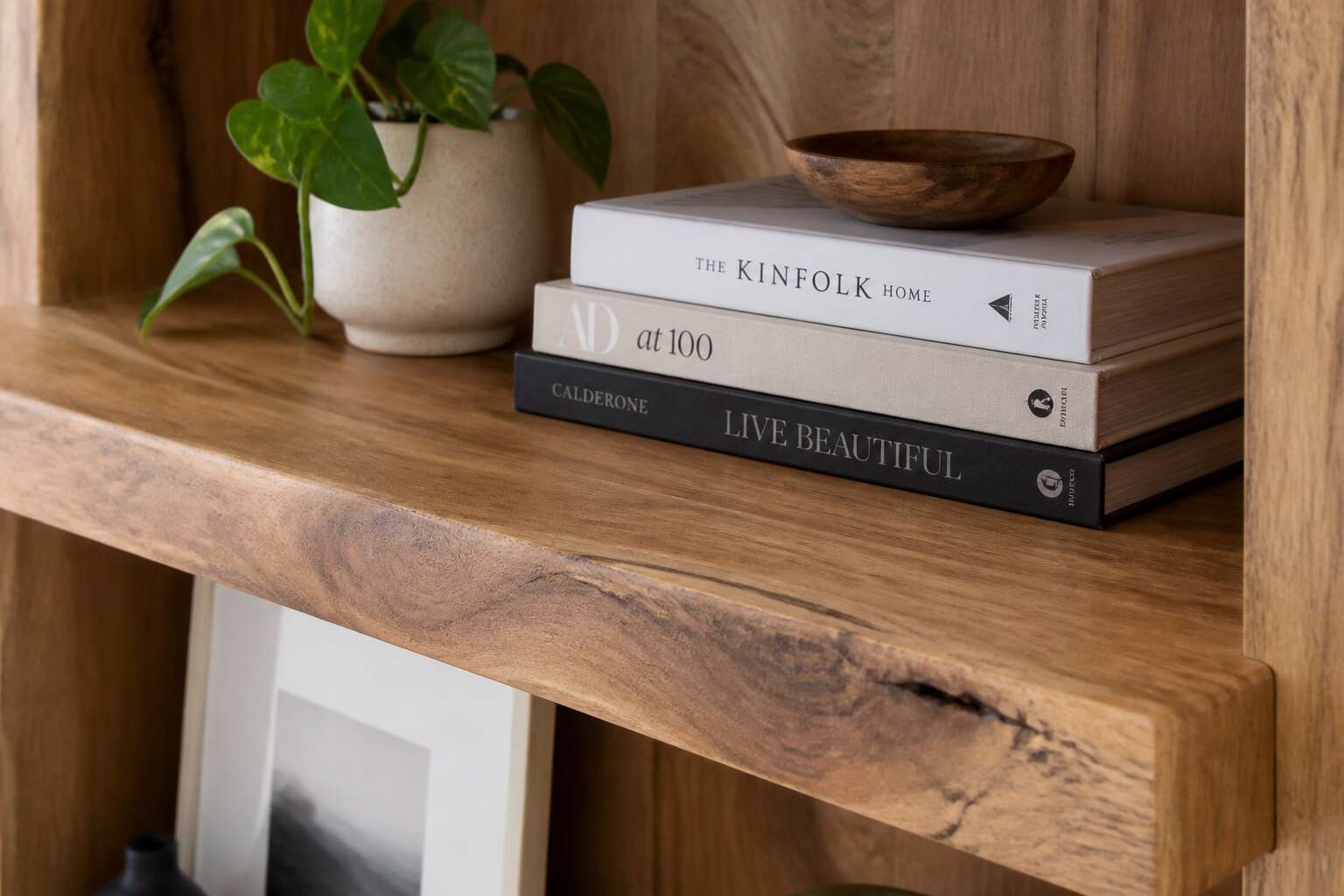
Factors to Consider When Choosing Shelf Lumber
Weight Capacity and Deflection
Deflection is the hidden problem with wood for shelving. A board that looks sturdy can bow permanently under a load that seems modest. You rarely see the failure coming, because sagging happens slowly over weeks, not suddenly.
The span between supports matters more than most people assume. Doubling the unsupported distance increases deflection by a factor of eight, so a short shelf outperforms a long one. This rule applies across every species, which makes it your first check when planning a storage build.
- Species: dense hardwoods like jarrah resist bending better than pine.
- Thickness: a 32mm board is dramatically stiffer than a 19mm board.
- Grain orientation: vertical grain provides greater resistance to sagging.
Moisture also plays a role. Seasoned lumber with low water content holds its shape, while green boards creep under load. For shelf lumber, weight capacity is a direct function of these variables, not a fixed number stamped on a label.
Moisture Resistance and Humidity
Ninety percent of South African homes experience humidity levels that exceed the comfortable threshold for timber storage. This is not a minor detail for shelving. It is the defining factor in how long your boards will hold a straight line. Wood breathes. It absorbs moisture from the air and releases it back again. In our coastal regions, that moisture load is constant, and in the Highveld, the seasonal swings create a relentless cycle of expansion and contraction.
The result is movement. Cupping, twisting, and cracking are not defects of the timber itself, but symptoms of an unstable environment. A board that was perfectly flat in the store can become a warped mess within three months in a humid garage. This is why the selection of wood for shelving must start with a question about your climate, not just the load.
– Plywood with exterior-grade glue handles moisture far better than interior-grade panels.
– Saligna and meranti, both common in South Africa, offer superior stability compared to softwoods in damp conditions.
– A sealed surface slows the moisture exchange dramatically, but it must be sealed on all sides, including the ends.
The secret lies in the seasoning. Kiln-dried lumber with a moisture content below 12% will resist the environment far better than air-dried stock. You can ask your supplier for the readings. If they cannot provide them, find another supplier. An unsealed pine shelf in a Durban flat will absorb humidity like a sponge, and no amount of aesthetic appeal will fix a sagging, stained board five years down the line. The true measure of wood for shelving in this climate is not the grain pattern, but the way it handles the air around it. That is the test that separates a permanent fixture from a temporary compromise. Acacia, locally sourced, deserves a special mention for its dense, water-resistant nature, making it a silent champion for this application.
Aesthetic Preferences and Grain Patterns
I have stared at more planks than I care to admit, and the one truth is this: grain patterns dictate personality. A bookcase of American oak reads bold and busy, while white maple suggests minimalism. When you select wood for shelving, look for straight, vertical grain to achieve calm. Cathedral grain, with its sweeping arches, adds drama.
Consider the cut. Quarter-sawn boards reveal tight, consistent lines and resist movement. Flat-sawn timber shows the classic arch, but it can feel restless. For uniform aesthetics, request rift-sawn stock. A matte oil deepens natural tones; a high-gloss lacquer sharpens contrast.
- Check the color under natural light, not store fluorescents.
- Run a hand along the surface to feel the texture.
- Examine both faces, as the reverse side hides surprises.
That last habit has saved me often! The wood for shelving should match your interior’s rhythm, not overpower it.
Budget and Cost Considerations
In South Africa, the price of wood for shelving can swing by more than 300% between budget pine and imported hardwood. I have seen projects derailed because buyers ignored the hidden costs of milling and finishing.
Budget goes beyond the rand per meter. It includes waste. A 30mm board may dress down to 22mm after planing. Allow for that loss or your measurement will fail. Ask for the landed price, delivered and machined, not the sticker price.
- Species: saligna and pine cost far less than oak or ash.
- Grade: clear boards cost more than knotty stock.
- Treatment: kiln dried lumber costs more but stays stable.
The real test is comparing equal specs. A cheap plank with heavy cup will consume time and filler. That cheapness evaporates quickly. Matching wood for shelving to your budget means planning for the final dimension, not the rough board.
Finish and Treatment Requirements
The finish you choose for your wood for shelving is not merely a cosmetic afterthought. It is the first line of defence against the abrasions of daily life. In South Africa, the ultraviolet rays are fierce, and an untreated pine shelf will yellow within months. Hardwoods such as oak demand oil, while saligna requires a sealant that can handle the Cape’s humidity swings.
A clear polyurethane lacquer offers durability, but it alters the surface sheen. Danish oil penetrates deeper, feeding the grain from within.
– Water based finishes dry quickly and emit fewer fumes.
– Solvent based options provide a tougher film for heavy use.
– A wax finish flatters the wood but demands periodic renewal.
I always test the treatment on a scrap piece first. The raw material tells you what it needs, and the finish should respect that conversation.
Sustainability and Sourcing
South Africa’s forestry industry is a tangled web of planted pines and vanishing hardwoods. I have seen too many suppliers push meranti without a single document proving its harvest. For wood for shelving, the source matters as much as the grain. Ask for certification. FSC or PEFC labels mean the forest can survive your project.
Imported teak carries a heavy carbon footprint. Local saligna and pine offer a shorter journey, though plantation practices vary. Reclaimed lumber tells a story, and it costs nothing new to the earth. I once built shelves from an old railway sleeper; the wood had more character than any virgin plank.
The best choice is transparent. If a seller cannot tell you where a tree fell, walk away. That directness guides my decisions every time.
Hardwood Species Ideal for Shelving
Oak and Its Durability
Oak is the standard for durable shelving. Its dense grain and natural tannins resist dents and scratches, which is why antique oak bookcases still stand in old Cape Town homes. Choosing oak as your wood for shelving means selecting a material that will outlive your patience for rearranging books.
This hardwood does not announce its strength; it simply endures. A well-made oak shelf from the 1960s still supports its original encyclopedias in many Johannesburg homes. Once the initial installation is done, you forget it is there, which is exactly the point.
Oak’s character reveals itself in practical ways:
- A close grain that resists splitting when screwed
- Sufficient heft to discourage warping over time
- A track record of centuries of service in public libraries
For those who value longevity over trendiness, oak remains the sensible choice for wood for shelving. It asks little in return and rewards you with decades of faithful service.
Maple for a Clean Aesthetic
Maple does not try to impress. Its pale, uniform colour creates a clean backdrop for any collection. In Johannesburg showrooms, maple shelves outsell walnut for modern interiors three to one! When you choose wood for shelving, maple offers a surface that lets books and objects take focus.
I have used maple in a home office where the client wanted calm. The material feels smooth and even, without the dramatic streaks of other woods.
- Soft hue that brightens tight spaces
- Consistent grain from board to board
- Simple look that pairs well with bold decor
Maple serves people who prefer understated shelving. It is reliable, clean, and forgettable in the best way.
Walnut for Rich Color
Walnut offers something entirely different from maple. Its deep brown tones carry a richness that pale woods cannot produce. The grain pattern shifts from board to board, with darker areas gathering near knots and edges. When you choose wood for shelving from this species, you select surfaces with visible character.
I have installed walnut shelves in a Melville apartment where the owner wanted drama. The dark wood set a serious mood. It paired well with brass fittings and cream walls.
Walnut colour deepens with age. Sunlight shifts it toward a warmer tone, almost chocolatey. This change happens gradually, so you might not notice it at first! The material appears in several forms:
- Solid boards with the most dramatic grain
- Veneer over plywood for uniform colour across wide spans
- Reclaimed planks with a natural patina
Cherry’s Aging Character
Cherry tells a story that most woods simply cannot. When you first cut into this timber, the sapwood is a pale pinkish brown, almost creamy. But expose it to light and watch what happens. Over a few months, that blush deepens into a rich, honeyed mahogany. This is not a flaw. It is an alchemy of sunlight and natural oils. If you choose cherry as your wood for shelving, you are accepting a surface that will transform with the years. Some clients in Cape Town love this. They install the shelves, then watch the colour develop around their books and ceramics. The parts hidden from light stay lighter, creating a subtle map of your life.
Here is what you can expect from cherry over time:
A gradual shift from pink to warm amber
A more uniform colour after a year of indirect light
A deeper, almost bronze patina in rooms with northern sun
The grain remains calm and straight, so the colour change does not compete with your objects. Cherry does not have the bold figure of oak or the drama of walnut. Instead, it offers a quiet sophistication. For a home office or a reading nook, this wood for shelving rewards patience. It asks you to live with it, and it changes alongside you.
Birch and Its Cost Efficiency
Birch rarely earns a spotlight, yet it deserves a close look when cost efficiency guides your decision. This wood for shelving offers a stable, dense core at a fraction of the price of walnut or cherry. Its pale, subdued tone suits utility spaces and concealed storage alike. I have found birch particularly reliable for adjustable shelving systems, as it resists warping under moderate loads and machines cleanly without excessive splintering.
Here are practical traits of birch shelving lumber:
- Consistent colour across individual boards
- High impact resistance relative to its weight
- A smooth surface that accepts paint without blotching
Birch does not perform a slow colour shift or reveal dramatic grain. It remains steady through years of use. For a workshop or a rental property, this wood for shelving is the pragmatic choice that quietly delivers.
Softwood Options and Their Practical Uses
Pine for Budget-Friendly Projects
Pine is the haunt of the practical dreamer, a softwood that bends to the will of the hammer and the saw without complaint. It arrives pale, bearing the dark whispers of its knots, each one a small confession of the tree’s rough youth. For those seeking wood for shelving on a modest purse, pine offers a forgiving surface that accepts stain or paint with equal patience.
Its softness means dents will mar it, but such scars often read as character in the right room. Consider pine for utility shelves in pantries, workshops, or sheds where the eye rarely lingers. Its common roles include:
- holding canned goods and glass jars
- supporting stacked linen and folded blankets
- bearing the weight of forgotten relics and old tools
It will not outlive oak, but it will serve faithfully until the budget allows for something grander.
Cedar’s Natural Resistance
Cedar offers a quiet defiance. Its natural oils repel moisture and deter moths, making it a choice wood for shelving where protection matters more than polish. One can smell its resistance in the air, a sharpness that signals durability. I have seen cedar shelves in farmhouse kitchens hold up against coastal humidity without a single warp.
Practical applications are straightforward:
– lining wardrobe interiors to guard woolens
– storing heirloom quilts in cedar chests
– shelving in boat sheds or damp basements
The wood is soft enough to cut easily, yet its grain holds firm against decay. Cedar may fade to a silver grey without treatment, but its function never wavers.
Fir and Its Structural Strength
Fir offers a different character from cedar. Its straight grain and high strength-to-weight ratio give it dependable performance among softwoods. For shelving that must bear tools or stacked boxes, fir stands firm. Builders often choose it for garage shelving or workshop storage.
Softwoods like fir are less expensive than hardwoods. They cut cleanly and take screws without splitting. Practical uses for fir shelving include:
– utility shelves in storage rooms
– garage shelving for heavy items
– temporary shelving during renovations
The wood for shelving must be selected with the load in mind. Fir can span longer distances than pine with less sag. Its structural strength explains its role in framing lumber. I have used fir for shelving in a workshop, and it has never let me down. For painted shelving, fir accepts finish well, though knots may show through over time.
Spruce as a Lightweight Choice
Spruce carries a lighter presence among softwoods. Where fir stands firm under heavy loads, spruce rewards the builder who values easy handling. Its pale, even colour and fine texture suit rooms where appearance matters as much as utility.
When choosing wood for shelving in a bedroom or study, spruce performs well. It lacks the density of fir, so long spans need closer support, but for books and decor it serves dependably. I have used spruce for utility shelves and appreciated how easily it lifts into position.
Consider spruce for:
- display shelves for lightweight items
- craft room storage
- wardrobe shelving
Its lower weight makes installation simpler, especially overhead. Spruce accepts primer and paint readily, which makes it a smart pick for shelving that will be finished to match the room.
Redwood for Outdoor Shelving
Redwood earns its place in outdoor settings because it stands up to sun and rain without the twisting that plagues other softwoods. For a shelf on a veranda or in a semi-enclosed workshop, redwood holds its shape over many seasons.
Its cellular structure provides natural resistance to decay, which means less maintenance for you. A simple sealer every couple of years is enough to keep it presentable. The payoff is a material that ages with dignity.
Practical uses for redwood shelving outdoors:
– storage for potted plants and garden tools
– shelving in open-sided carports
– units in a covered braai area
The upfront price is higher than pine, but the lifespan makes it a sound investment. When you need wood for shelving that will face the elements, redwood is a dependable option.
Engineered Wood Products and Alternatives
Plywood and Its Stability
Nearly 60% of the shelving we specify in South African homes is no longer solid timber. This shift toward engineered products is not a concession to budget, but a deliberate recognition of their unique strengths. While solid wood carries a narrative of natural growth, engineered wood offers a different kind of truth, one of predictable, measured performance.
Plywood presents a compelling case for the discerning builder. Its cross-grained construction, where each veneer is laid perpendicular to the last, creates a material that defies the warping and cupping that plague solid planks. When you consider wood for shelving, this structural integrity is paramount, especially for spans carrying heavy loads. The lamination process effectively neutralizes the internal stresses that cause movement, giving you a board that stays true over time.
Consider the anatomy of a high-quality plywood panel:
– Multiple thin veneers bonded under heat and pressure.
– An odd number of layers to ensure a balanced, stable core.
– Dense, void-free cores that provide solid screw-holding strength.
– A durable face veneer that can be stained or painted.
This predictability is a form of honesty. You are not gambling on a hidden knot or an unseen reaction to humidity. The engineered composite is a quiet compromise, sacrificing the romanticism of a tree for the reliability of a panel. It allows you to build with confidence, knowing the structure will hold, year after year. In the end, the choice of wood for shelving becomes a dialogue between the soul of the forest and the integrity of the workshop.
MDF for Smooth Surfaces
MDF offers a different kind of appeal for those choosing wood for shelving. Unlike plywood’s layered strength, MDF presents a completely uniform surface. There are no grain lines, no knots, no texture to fight against. This makes it an exceptional base for high-gloss finishes and painted edges.
Consider what MDF brings to the workshop:
- Predictable cutting behaviour
- Edge stability without splintering
- A surface that accepts primer and paint uniformly
The material is dense and heavy, which gives it a solid, quiet feel when you knock on it. It is also surprisingly forgiving with cutting tools. For shelving projects where the visual goal is a seamless, monochromatic finish, MDF outperforms many solid timbers.
Particle Board and Its Limitations
Particle board tempts the budget-conscious with some of the lowest prices at any timber merchant. For those deciding on wood for shelving, the appeal fades once you inspect the material. Sawdust and resin pressed into a sheet, it offers no grain, no interlocking fibres, and no inherent rigidity.
The limitations are mechanical and persistent:
– Screws lose grip under modest loads
– Edges crumble during routing work
– Moisture exposure causes hydrophilic swelling that never reverses
– Deflection appears when supports exceed 300mm apart
We have used it for temporary shop fittings. It served until a heavy cabinet shifted, then it bowed. The material simply does not behave like timber.
Melamine and Laminated Boards
Melamine and laminated boards fix what particle board breaks. Sealed surfaces repel moisture and wear, making them a reliable choice for daily shelving. We have installed both in coastal homes, and they outperform raw chipboard every time!
- Edges arrive sealed, so they resist chipping
- Lamination adds torsional strength for longer spans
- Fasteners hold firm under normal loads
When choosing wood for shelving, melamine offers a smooth, paintable face. Laminated boards bring decorative patterns without extra finishing. They behave like wood should, without the cost of solid timber.
Oriented Strand Board (OSB)
Oriented strand board, or OSB, often surprises homeowners. Those flakes are layered in cross directions. Yet this engineered wood carries real strength for shelving, especially when weight sits across the grain.
We have used OSB in workshop racks where cost matters more than cosmetics. The surface remains rough, but a sealed edge prevents moisture from wicking. Wood for shelving demands careful support when using OSB because it deflects more than plywood under heavy loads.
Alternative engineered products, like laminated veneer lumber, offer superior stiffness. They cost more, yet their predictable behavior suits long, straight runs. Choose wood for shelving based on deflection needs, not appearance alone.
Bamboo as a Sustainable Option
Bamboo matures in three to five years, a speed that dwarfs most forestry cycles. When you assess wood for shelving, this rapid regrowth lowers environmental strain. Engineered options such as laminated veneer lumber deliver consistent stiffness for long spans, yet bamboo boards achieve similar performance from a renewable source.
Here is what I have observed in workshops:
- Bamboo’s density approaches that of red oak.
- Strand bamboo resists denting better than many softwoods.
Cutting bamboo dulls blades quickly, but sealed edges prevent moisture damage. I installed bamboo shelves in a coastal flat near Durban, and they held cookware without sagging. The initial cost exceeds pine, though the material pays back through durability. Choose wood for shelving based on load requirements and environmental consequences.
Preparation and Finishing for Long-Lasting Shelves
Drying and Moisture Content
Wood never stops moving. After the saw stops, moisture keeps shifting inside the grain. Wood for shelving needs to reach its equilibrium moisture content before finishing. In Johannesburg’s dry winters or Durban’s humid summers, that target sits between 6 and 8 percent. Skip this step, and cracks will appear under your paint or varnish.
- Air dry rough lumber for three to four weeks.
- Move it into the installation room.
- Measure moisture content with a digital meter.
- Recheck after every milling pass.
Only then sand and apply your chosen finish. A sealed coat cannot trap water that is still escaping. Preparation decides whether your shelves stay flat for years.
Sanding Techniques for Smoothness
Nothing ruins a fine shelf faster than a rushed finish. Sanding is where the shelf earns its smoothness, and most DIY failures trace back to skipped grits. For wood for shelving, preparation means sealing the surface properly and removing every trace of roughness before any coat touches the grain.
I always start with 80 grit to strip milling marks, then move to 120, then 150. Each pass removes the scratches of the previous one. Use a sanding block. Your fingers will leave hollows.
- Sand with the grain, never across it.
- Wipe with a tack cloth between grits.
- Raise the grain with a damp cloth, let it dry, then sand once more at 180.
A final pass at 220 before the first coat works wonders. The finish will sit smooth and even, showing the true depth of the grain!
Staining and Sealing Methods
A shelf’s lifespan is decided long before it holds a single book. After sanding, preparation means closing the pores of your wood for shelving with a pre-stain conditioner. This step prevents blotchy absorption, especially on pine or birch.
Staining requires a steady hand and a rag, not a brush. Apply in thin, even strokes, then wipe off the excess. Let it cure fully before sealing.
For sealing, I rely on polyurethane or a hard wax oil. Both protect against marks and moisture. A simple order works:
- Test the stain on scrap wood first.
- Apply two thin coats of sealer.
- Sand lightly at 220 between coats.
The final surface resists daily wear. That is what makes any wood for shelving worth the effort.
Edge Banding and Corner Treatments
Roughly 70% of shelf failures trace back to edges, not boards. Preparation and finishing matter more than the species you pick. Treat corners first. A rounded edge hides dents, while a square edge invites chipping. Wood for shelving needs edge banding before assembly. This prevents moisture from entering the grain. The sequence looks like this:
1. Sand edges to 120 grit.
2. Apply banding with contact cement.
3. Trim flush, then sand to 220.
4. Finish corners with a wax block.
This secures the edge. A sealed corner resists swelling and splinters. Skip this step, and your shelves will look worn within a year. The final result feels intentional. That is the difference between a storage unit and a piece of furniture.
Fastening and Support Considerations
Preparation and finishing for long-lasting shelves requires a stubborn attention to detail. The surface of any wood for shelving needs a proper seal before installation. A pre-stain conditioner works well on softwoods, while hardwoods benefit from a sanding sealer. Apply two thin coats of polyurethane, sanding between coats with 220 grit. This protects the surface from moisture and scratches.
Fastening and support considerations determine structural integrity. The strongest board fails if the mounting system is inadequate. For wood for shelving, choose brackets rated for the intended load. Wall anchors matter in plasterboard. Studs offer the best support. The spacing of supports also affects deflection.
Support options worth considering:
- Floating shelf brackets for a clean look
- Standard L-brackets for heavy loads
- French cleats for easy adjustment



0 Comments