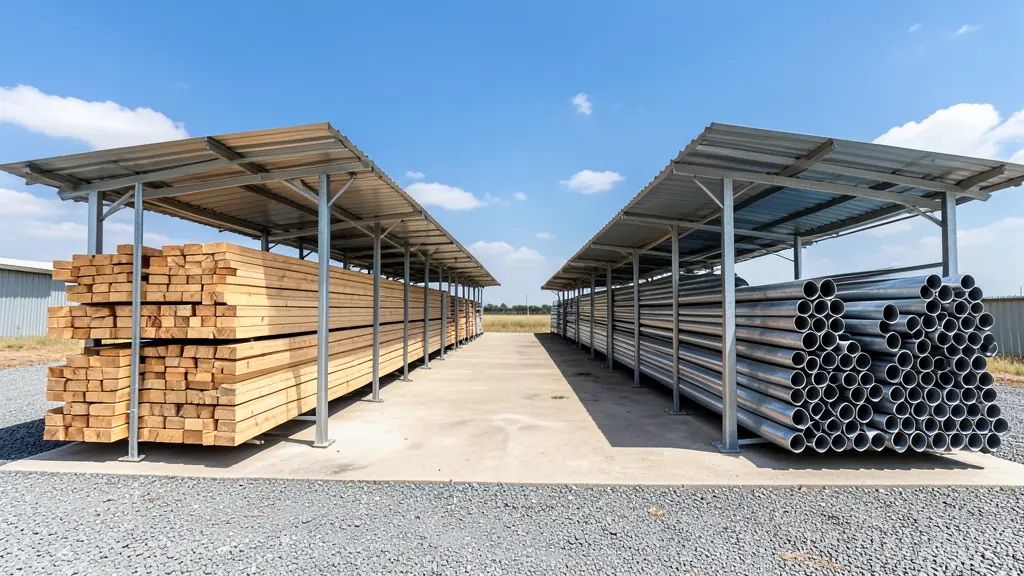
Cantilever racking is built for loads that will not sit on a pallet: timber, steel pipe and bar, sheet, PVC pipe, carpet rolls and doors. Each column stands on a long base with arms reaching out on one or both sides, and there are no front uprights in the way. That open front lets a forklift or side loader slide long lengths in and out freely. Hardware stores, steel merchants, builders' yards and joinery shops use it indoors and outdoors. This page covers the choices, the loads and what to send for a quote.
Single or double sided
Single sided cantilever racking stands against a wall or fence with arms on one side. Double sided runs stand in the middle of a yard or building with arms on both sides, so you load from two aisles. The columns are joined along the run by bracing, and the arms bolt or hook into the column at heights that can be changed. Long items should rest on enough arms that they do not sag between them; the supplier spaces the columns to suit your shortest and longest lengths.
Arms and loads
The maker rates each arm and each column, and those figures belong on the load notice. Arm length is set by the depth of the load: a bundle of pipe needs less depth than a stack of wide sheet. Stoppers at the arm tips keep round items from rolling off. Never load beyond the rating or add your own arms; ask the supplier for matching parts. For flat sheet and short pieces, decks can be fitted across the arms. Load each side evenly where you can, keep the heaviest bundles on the lower arms, and check that the load notice matches the arm positions actually in use.
Indoors or out
Indoors, a painted finish is usually enough. In an open yard the racking should be galvanised, especially near the coast where salt air rusts painted steel quickly, and a roof of sheeting on the top arms keeps timber dry. Outdoor racking still needs a sound concrete base for the anchors; an engineer may need to check it for tall runs or wind loads. Plan protection at the run ends where trucks turn. On the Highveld, open sheds see dust and big temperature swings, so a galvanised finish is worth considering there too.
Loading equipment
A counterbalance forklift with long forks works for many yards, but it needs wide aisles to turn long loads. Side loaders and multi-directional trucks carry lengths sideways down narrower aisles. Tell the supplier which you use. For cartons and bulky light items next to the cantilever runs, longspan racking is common, and a layout design helps when you are planning a new yard.
What to put in your request
- Longest and shortest lengths you store
- Weight and size of the heaviest bundle
- Indoors, or outdoors in an open yard
- Single sided against a wall or double sided
- Forklift or side loader used to load it
Cantilever Racking for warehouses, shops, workshops and homes
- Warehouses and distribution centres: a run of cantilever racking for long building products in a general store
- Factories and manufacturers: steel bar, tube and sheet stored by the cutting area in a fabrication shop
- Shops, supermarkets and spaza shops: timber, pipe and doors in a hardware store's yard or trade counter
- Wholesalers and building supply yards: steel merchants and builders' supply yards with long lengths by the tonne
- Workshops, contractors and trades: a joinery or engineering shop storing timber boards or steel lengths
- Offices, archives, schools and hospitals: not used for office storage
- Restaurants, caterers and wine cellars: seldom used, sometimes for long items in a hotel's maintenance yard
- Homeowners: a small wall-mounted cantilever rack for timber or pipe in a garage
- Farms, packhouses and co-ops: pipe, poles and steel for irrigation and fencing in a farm yard
Frequently asked questions
Do you supply cantilever racking yourselves?
No. We pass your request to independent racking suppliers and installers who work in your area, and they quote you directly. We do not make, sell or install racking, and we give no engineering advice.
Can cantilever racking stand outside?
Yes, when it is galvanised and anchored to a suitable concrete base. Many yards add roof sheeting to the top arms to keep timber and boards dry. Ask the supplier about the finish for your climate, especially within reach of salt air on the coast, and about the base the columns will be anchored to.
How much can each arm carry?
It depends on the arm length, the column and the maker. Each maker rates its arms and columns, and the rating should be on the load notice. Give the supplier the weight and size of your heaviest bundle, and how many bundles go on each level, so the arms and columns can be sized to the real load.
What should I send for a quote?
Send the longest and shortest lengths, the heaviest bundle, how much you store at a peak, whether it is indoors or outdoors, and the truck you load with. A rough plan of the yard or building helps.
Cantilever Racking by province and city
- Johannesburg
- Pretoria
- Centurion
- Midrand
- Sandton
- Randburg
- Roodepoort
- Krugersdorp
- Randfontein
- Germiston
- Boksburg
- Benoni
- Kempton Park
- Alberton
- Vanderbijlpark
- Vereeniging
- Durban
- Pinetown
- Pietermaritzburg
- Richards Bay
- Newcastle
- Ladysmith
- Gqeberha (Port Elizabeth)
- East London
- Kariega (Uitenhage)
- Mthatha
- Cape Town
- Bellville
- Paarl
- Stellenbosch
- George
- Worcester
- eMalahleni (Witbank)
- Middelburg
- Secunda
- Mbombela (Nelspruit)
- Rustenburg
- Brits
- Klerksdorp
- Potchefstroom
- Mahikeng
- Polokwane
- Tzaneen
- Kimberley
- Upington
- Bloemfontein
- Welkom
- Sasolburg