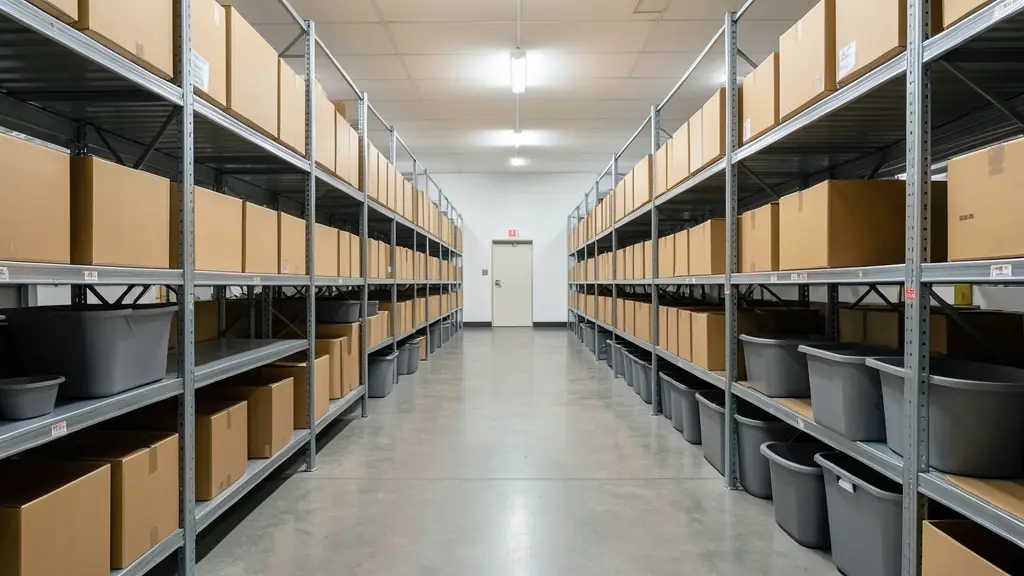
Steel shelving is the everyday answer for stock you pick by hand: cartons, spares, files, tools and anything that does not arrive on a pallet. A bay is four uprights with steel shelves set at the heights you choose, and the next bay shares two of those uprights, so a run grows cheaply. This page explains bolted and boltless shelving, finishes, bay sizes and how shelf loads are rated. Send one request and suppliers and installers who work in your area quote you directly.
Bolted or boltless
Bolted shelving uses slotted angle uprights with shelves fixed by nuts and bolts at each corner. It is cheap, strong for its weight and easy to move, but changing a shelf height takes a spanner and some patience. Boltless shelving has shelves or beams that clip or rivet into keyhole slots in the uprights, so a shelf moves in a minute with a rubber mallet. Most storerooms and spares stores now use boltless; bolted still suits tight budgets and odd sizes. For bins, drawers and parts trays, see industrial shelving.
Galvanised or powder coated
Galvanised shelving has a zinc coating that resists rust, which matters in damp storerooms, unheated sheds, garages and coastal towns where salt air gets in. Powder coated shelving is painted and baked, usually grey, blue or white, and looks neater in an office, shop back room or archive. A chip in the paint can rust in a wet place, so choose galvanised where the shelving will meet water or humidity.
Shelves can also come with chipboard or melamine tops for a smoother surface, and accessories such as back panels, side panels, dividers, plastic bins and doors turn an open bay into a tidy cupboard. Ask which accessories fit the system before you buy, because they are seldom shared between makers.
Sizes, adjustment and loads
Bays come in standard heights, widths and depths, and shelves adjust in steps along the uprights. Measure the space, the ceiling height, doors and light fittings, and the size of your biggest carton or box before choosing a depth. Deep shelves hold more but are harder to pick from the back.
Shelf loads are rated by the maker per shelf and per bay, and depend on the shelf width, its supports and how evenly the load is spread. Ask the supplier for the rating of the exact bay you are buying. If your stock is heavier, look at heavy-duty shelving or longspan racking.
Where steel shelving is used
- storerooms and back rooms of shops and wholesalers
- workshops, maintenance stores and spares rooms
- offices, schools and archives for files and boxes
- home and business garages (see garage shelving)
- pantries, kitchens and cold rooms, where wire or stainless shelving often suits better
Fit tall bays with back braces, fix them to the wall or to each other where they could tip, and keep the heaviest items on the lower shelves.
What to put in your request
- The room size, ceiling height and where doors and windows are
- How many bays, and the height, width and depth you want
- What goes on the shelves and the heaviest item per shelf
- Bolted or boltless, galvanised or powder coated
- Whether you want delivery only or delivery and installation
Steel Shelving for warehouses, shops, workshops and homes
- Warehouses and distribution centres: picking shelves for small cartons and loose items beside the pallet racking
- Factories and manufacturers: storerooms for consumables, packaging and small parts near the production line
- Shops, supermarkets and spaza shops: back room shelving for stock waiting to go out onto the shop floor
- Wholesalers and building supply yards: shelving for slow lines, samples and small cartons in the store
- Workshops, contractors and trades: spares and tools on adjustable shelves along the workshop wall
- Offices, archives, schools and hospitals: files, boxes and stationery in a storeroom or archive
- Restaurants, caterers and wine cellars: dry stores for kitchens, linen rooms and housekeeping stock
- Homeowners: a few bays in the garage or storeroom for boxes and tools
- Farms, packhouses and co-ops: galvanised shelving in the store for spares, chemicals and small tools
Frequently asked questions
Do you sell or install shelving yourselves?
How much weight can a steel shelf carry?
Can I assemble boltless shelving myself?
What is an add-on bay?
Steel Shelving by province and city
- Johannesburg
- Pretoria
- Centurion
- Midrand
- Sandton
- Randburg
- Roodepoort
- Krugersdorp
- Randfontein
- Germiston
- Boksburg
- Benoni
- Kempton Park
- Alberton
- Vanderbijlpark
- Vereeniging
- Durban
- Pinetown
- Pietermaritzburg
- Richards Bay
- Newcastle
- Ladysmith
- Gqeberha (Port Elizabeth)
- East London
- Kariega (Uitenhage)
- Mthatha
- Cape Town
- Bellville
- Paarl
- Stellenbosch
- George
- Worcester
- eMalahleni (Witbank)
- Middelburg
- Secunda
- Mbombela (Nelspruit)
- Rustenburg
- Brits
- Klerksdorp
- Potchefstroom
- Mahikeng
- Polokwane
- Tzaneen
- Kimberley
- Upington
- Bloemfontein
- Welkom
- Sasolburg