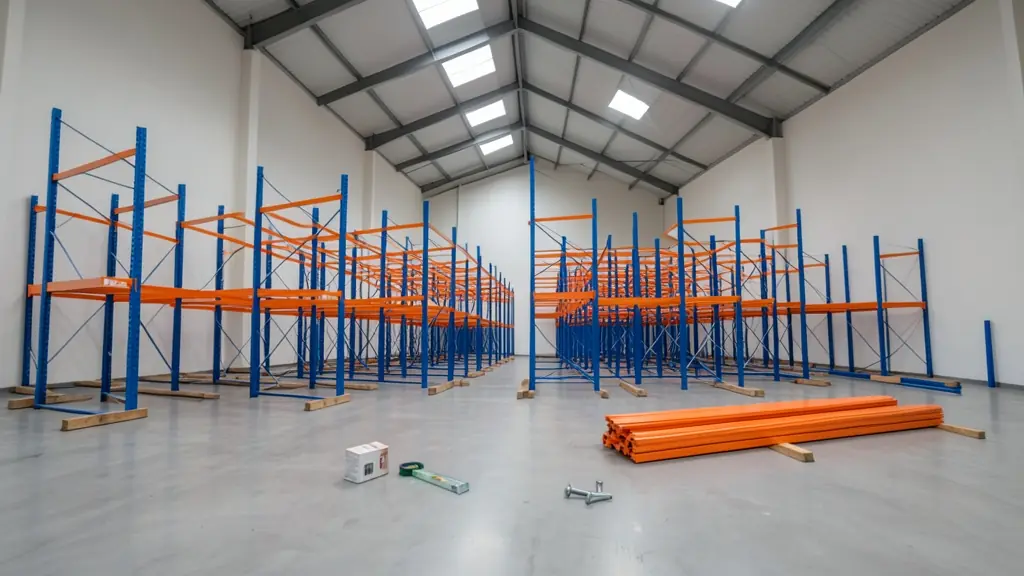
Good steel can still make bad racking if it is put up badly. Racking installation is the work of turning a layout drawing into straight, level runs that are anchored to the slab, with every beam locked and the safe loads posted on the end of each run. This page explains what installers do, what has to be checked before the first frame goes up, and how to plan an install in a warehouse that keeps working. Send one request and independent installers who work in your area quote you directly.
Start with the drawing and the slab
An installer works from a layout drawing (plan and elevation) and a load schedule that shows the frame heights, beam lengths, beam levels and the load per beam pair and per bay. If you do not have one yet, ask for it as part of the job or see warehouse layout and storage design. The slab matters as much as the steel: its thickness, condition and saw cut joints all affect where base plates can go and which anchors hold. For heavy or tall racking, ask an engineer to confirm the slab can take the point loads under each upright.
How a run goes up
A trained installation crew usually works in this order:
- sets out the aisles and the line of each run on the floor
- stands the frames and fits the beams at the drawn levels, with a safety lock or clip in every beam end
- plumbs each frame (vertical in both directions) and levels it with shims under the base plates
- drills and fixes the base plates to the slab with the anchors the maker specifies
- fits row spacers on back to back runs, then decks, pallet supports and column guards
- fixes the load notice to each run
Everything follows the maker's instructions, so mixing parts from different systems is a bad idea.
Sprinklers, fire and a live warehouse
Racking changes how a building's sprinklers work, and the top of the load must stay clear below the sprinkler heads. Talk to your fire installer early: some taller or denser layouts need in-rack sprinklers, and SANS 10287 covers automatic sprinkler installations. The local fire department may also want to see the layout. If the warehouse stays open during the install, agree on closed zones, forklift routes and hours with the installer so stock keeps moving without anyone working under a load.
Sign-off and handover
Before you load, walk the job with the installer. Check that frames look straight, every beam has its locks, every base plate is anchored and every run has a load notice that matches the drawing. Ask for the as-built drawing and the load schedule for your records, and plan the first racking inspection as part of your normal safety routine.
What to put in your request
- The layout drawing and load schedule, if you have them
- The racking system and maker, or what is still to buy
- The number of bays, frame heights and beam levels
- The slab: age, thickness if known, cracks or joints
- Whether the warehouse stays open during the install
Racking Installation for warehouses, shops, workshops and homes
- Warehouses and distribution centres: new runs of pallet racking set out, plumbed and anchored before the first delivery
- Factories and manufacturers: racking for raw material and finished goods installed around production that keeps running
- Shops, supermarkets and spaza shops: storeroom racking and longspan bays put up behind the shop over a weekend
- Wholesalers and building supply yards: tall pallet racking installed in a bigger building with aisles set for the forklifts
- Workshops, contractors and trades: a few bays of racking for parts and tyres, anchored and fitted with load notices
- Offices, archives, schools and hospitals: archive shelving and longspan bays put up and fixed in a basement storeroom
- Restaurants, caterers and wine cellars: racking for dry goods and cases in a hotel or catering store installed and anchored
- Homeowners: a garage or storeroom fitted with shelving bays fixed to the wall
- Farms, packhouses and co-ops: racking in a packshed or feed store set out around the forklift and pallet jacks
Frequently asked questions
Do you install racking yourselves?
Can you install racking I already bought?
Does all racking have to be bolted to the floor?
How long does an installation take?
Racking Installation by province and city
- Johannesburg
- Pretoria
- Centurion
- Midrand
- Sandton
- Randburg
- Roodepoort
- Krugersdorp
- Randfontein
- Germiston
- Boksburg
- Benoni
- Kempton Park
- Alberton
- Vanderbijlpark
- Vereeniging
- Durban
- Pinetown
- Pietermaritzburg
- Richards Bay
- Newcastle
- Ladysmith
- Gqeberha (Port Elizabeth)
- East London
- Kariega (Uitenhage)
- Mthatha
- Cape Town
- Bellville
- Paarl
- Stellenbosch
- George
- Worcester
- eMalahleni (Witbank)
- Middelburg
- Secunda
- Mbombela (Nelspruit)
- Rustenburg
- Brits
- Klerksdorp
- Potchefstroom
- Mahikeng
- Polokwane
- Tzaneen
- Kimberley
- Upington
- Bloemfontein
- Welkom
- Sasolburg