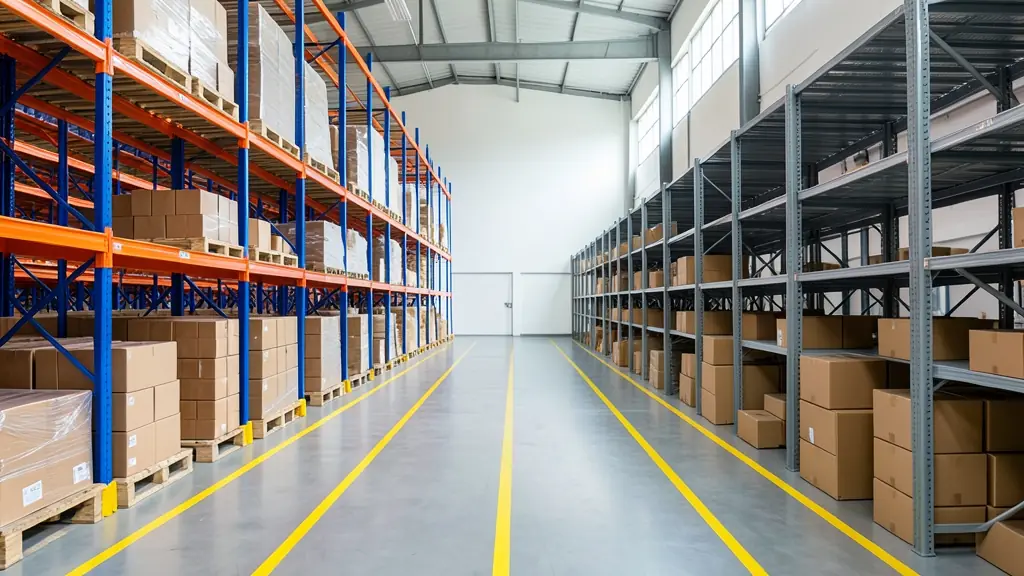
Racking and shelving is how most businesses in South Africa get stock off the floor, out of the way and easy to find. Racking usually means steel systems loaded by forklift or reach truck, built from frames and beams. Shelving means bays you load by hand, in a storeroom, workshop, shop or garage. The right choice depends on what you store, how heavy it is, the building you have and the equipment you load it with. This page sets out the main kinds, what to think about before you buy and how to get quotes from suppliers near you.
Racking or shelving?
If your stock arrives on pallets and moves by forklift, you need racking. Pallet racking is the common choice, with drive-in racking for many pallets of one product and narrow aisle racking where floor space is tight. Cantilever racking carries long lengths such as timber and pipe. If people pick cartons, parts and files by hand, you need shelving: steel shelving for general stores, heavy-duty shelving for weight, and longspan racking in between, for bulky light goods on long beams.
How to choose
Start with the stock, not the steel. Count your pallets or cartons, weigh the heaviest load, and note how many product lines you carry and how fast they move. Then look at the building: the clear height under the roof and sprinklers, the column grid, the doors and the condition of the slab. Last, the handling equipment: a counterbalance forklift, a reach truck or pallet jacks and people. A supplier turns this into a drawing and a load schedule, and for a large or new warehouse a layout design is worth doing first.
Safety comes with the steel
Load ratings come from the maker: per beam pair and per bay for racking, per shelf for shelving. They belong on a load notice fixed to the run, and nobody should load past them. Racking is anchored to the slab and set plumb by trained installers, and tall shelving is fixed or braced so it cannot tip. Forklift knocks are the main cause of damage, so plan protection at aisle ends and get regular racking inspections once the system is in use.
What affects the price
Cost depends on the system, the height and the load, the number of bays, accessories such as decks and guards, delivery, installation and anchors, site access and the steel price at the time. Stock shelving can often be delivered in days, while pallet racking and custom systems take longer, so ask the supplier for a lead time with the quote. Used racking can save money if every part is checked. When you compare quotes, check that each one covers the same number of bays, the same load per level, delivery, anchors and installation, and whether VAT is included, so you are comparing like with like.
What to put in your request
- What you store: pallets, cartons, long lengths or parts
- The heaviest pallet or shelf load you expect
- The floor area and clear height of the building
- How you load it: forklift, reach truck or by hand
- Whether you need installation, delivery or both
Racking and Shelving for warehouses, shops, workshops and homes
- Warehouses and distribution centres: pallet racking for bulk stock with longspan or shelving for small picks
- Factories and manufacturers: racking for raw material and finished goods, shelving for spares and tools
- Shops, supermarkets and spaza shops: shop shelving on the floor and steel shelving in the storeroom behind it
- Wholesalers and building supply yards: pallet racking for cases and bags, with cantilever racking for long building products
- Workshops, contractors and trades: heavy-duty shelving for parts and tools, and racking for drums and heavy spares
- Offices, archives, schools and hospitals: steel or mobile shelving for files, archive boxes and stationery
- Restaurants, caterers and wine cellars: stainless or wire shelving in kitchens and cold rooms, wine racking in the cellar
- Homeowners: garage shelving, storeroom bays and wall shelves to clear the floor
- Farms, packhouses and co-ops: racking in packsheds and feed stores, shelving for tools and spares in the shed
Frequently asked questions
Do you sell or install racking and shelving yourselves?
No. We are a free quote request service. You send one request and we pass it to independent suppliers, manufacturers and installers who work in your area. They quote you directly, and you choose who to use. We make, sell and install nothing ourselves.
What is the difference between racking and shelving?
Racking is built for forklift loading, with upright frames and pairs of beams at set levels, usually holding pallets. Shelving is loaded by hand, with uprights and steel shelves that adjust in steps. Longspan racking sits between the two.
How much weight can racking or shelving carry?
It depends on the product. Each maker rates its racking per beam pair and per bay, and its shelving per shelf, and the figures should be shown on the load notice. Give the supplier your heaviest load and let them size the system to it.
Does racking have to be bolted to the floor?
Pallet racking is normally anchored to the slab through its base plates, and tall shelving should be anchored or fixed to a wall. The installer follows the maker's instructions, and for heavy or tall racking an engineer may need to check the slab.
Racking and Shelving by province and city
- Johannesburg
- Pretoria
- Centurion
- Midrand
- Sandton
- Randburg
- Roodepoort
- Krugersdorp
- Randfontein
- Germiston
- Boksburg
- Benoni
- Kempton Park
- Alberton
- Vanderbijlpark
- Vereeniging
- Durban
- Pinetown
- Pietermaritzburg
- Richards Bay
- Newcastle
- Ladysmith
- Gqeberha (Port Elizabeth)
- East London
- Kariega (Uitenhage)
- Mthatha
- Cape Town
- Bellville
- Paarl
- Stellenbosch
- George
- Worcester
- eMalahleni (Witbank)
- Middelburg
- Secunda
- Mbombela (Nelspruit)
- Rustenburg
- Brits
- Klerksdorp
- Potchefstroom
- Mahikeng
- Polokwane
- Tzaneen
- Kimberley
- Upington
- Bloemfontein
- Welkom
- Sasolburg