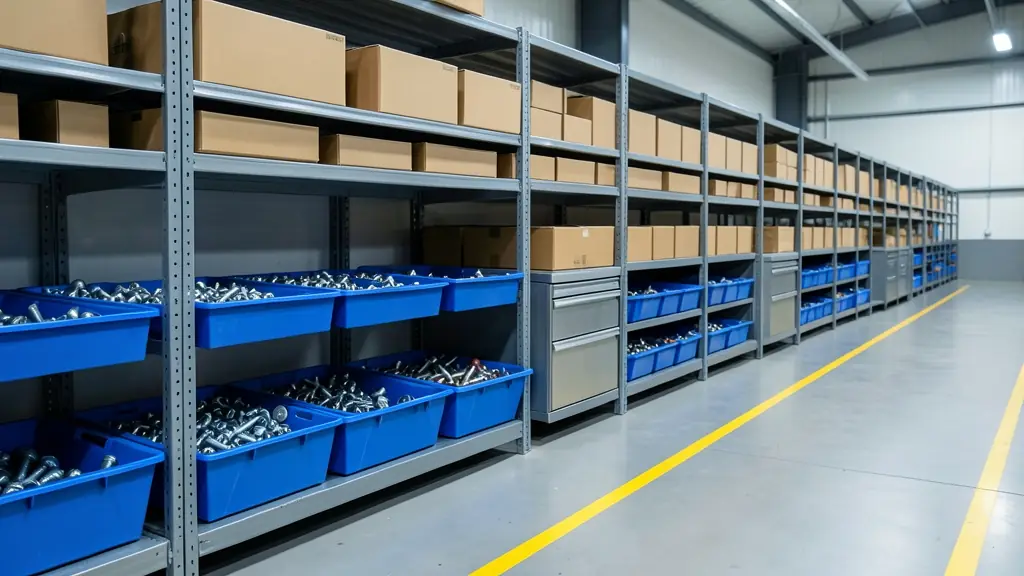
Industrial shelving is shelving built for a working stores: a factory maintenance store, a spares room, a mine store or a busy workshop. It is stronger than light office shelving and is fitted out with bins, dividers, drawers and parts trays so that thousands of small items each have a place. This page covers what goes into an industrial shelving layout, multi-tier stores and how bin locations keep stock under control. Send one request and shelving suppliers and installers in your area quote you directly.
What makes shelving industrial
Industrial bays use heavier uprights and shelves than the light shelving sold for homes, and often have beams under the shelf or reinforced shelf panels. Bays are usually boltless so that levels can change as stock changes. The maker rates each shelf, and that rating should suit what you actually store: a shelf of bearings or fittings gets heavy fast. If your heaviest items are engine parts, gearboxes or full drums, look at heavy-duty shelving. For the basics of bolted and boltless bays, see steel shelving.
Bins, dividers, drawers and trays
The fittings make the stores work:
- plastic picking bins with an open front for small, fast parts
- shelf dividers to split a shelf into sections
- drawer units that fit inside a bay for small, valuable or delicate parts
- parts trays and shallow boxes for fittings, seals and fasteners
- back and side panels so nothing falls through
Plan the fittings around your stock list, not the other way round.
Bin locations and stores control
A good stores gives every item a bin location: a code for the aisle, bay, shelf and bin that matches the stock system. Pickers find parts faster, stock counts are quicker and missing items show up. Put fast-moving parts at waist height near the counter, slow ones high or at the back, and heavy parts on the lower shelves. A lockable cage or counter keeps the stores controlled. A supplier or a storage designer can draw the layout for you.
Leave aisles wide enough for a picking trolley, keep a clear area at the counter for receiving and issuing, and plan space for growth. A stores that is full on the day it opens soon ends up with parts on the floor and in the aisles, where they get damaged and lost.
Multi-tier shelving
When the building is tall and the floor is full, shelving can go up two or three tiers with steel walkways, stairs and handrails between them. Multi-tier shelving carries a walkway on the shelving itself, so it must be designed and installed to the maker's rules. It is close to a mezzanine floor, and building plans, fire rules and an engineer may come into it. Ask the municipality and the engineer before you commit.
What to put in your request
- The floor area and clear height of the stores
- Your stock list: how many lines, sizes and heaviest parts
- Which bins, drawers, dividers or trays you want
- Whether you need a counter, cage or multi-tier layout
- Delivery only, or delivery and installation
Industrial Shelving for warehouses, shops, workshops and homes
- Warehouses and distribution centres: small parts picking zones with bins beside the main pallet racking
- Factories and manufacturers: maintenance stores for bearings, belts, seals and spares for the plant
- Shops, supermarkets and spaza shops: back room shelving with bins for small hardware and fittings
- Wholesalers and building supply yards: picking shelves for small lines in a hardware or electrical wholesaler
- Workshops, contractors and trades: spares, fasteners and consumables in bins at the workshop counter
- Offices, archives, schools and hospitals: stationery, IT spares and consumables in a controlled storeroom
- Restaurants, caterers and wine cellars: maintenance and engineering stores in hotels and large kitchens
- Homeowners: rarely needed at home, but bins on shelving suit a home workshop
- Farms, packhouses and co-ops: a farm store with bins for fittings, irrigation parts and spares
Frequently asked questions
Do you supply or fit industrial shelving?
How do I work out how many bays I need?
Can I add bins and drawers to shelving I already have?
Should industrial shelving be fixed to the floor or wall?
Industrial Shelving by province and city
- Johannesburg
- Pretoria
- Centurion
- Midrand
- Sandton
- Randburg
- Roodepoort
- Krugersdorp
- Randfontein
- Germiston
- Boksburg
- Benoni
- Kempton Park
- Alberton
- Vanderbijlpark
- Vereeniging
- Durban
- Pinetown
- Pietermaritzburg
- Richards Bay
- Newcastle
- Ladysmith
- Gqeberha (Port Elizabeth)
- East London
- Kariega (Uitenhage)
- Mthatha
- Cape Town
- Bellville
- Paarl
- Stellenbosch
- George
- Worcester
- eMalahleni (Witbank)
- Middelburg
- Secunda
- Mbombela (Nelspruit)
- Rustenburg
- Brits
- Klerksdorp
- Potchefstroom
- Mahikeng
- Polokwane
- Tzaneen
- Kimberley
- Upington
- Bloemfontein
- Welkom
- Sasolburg