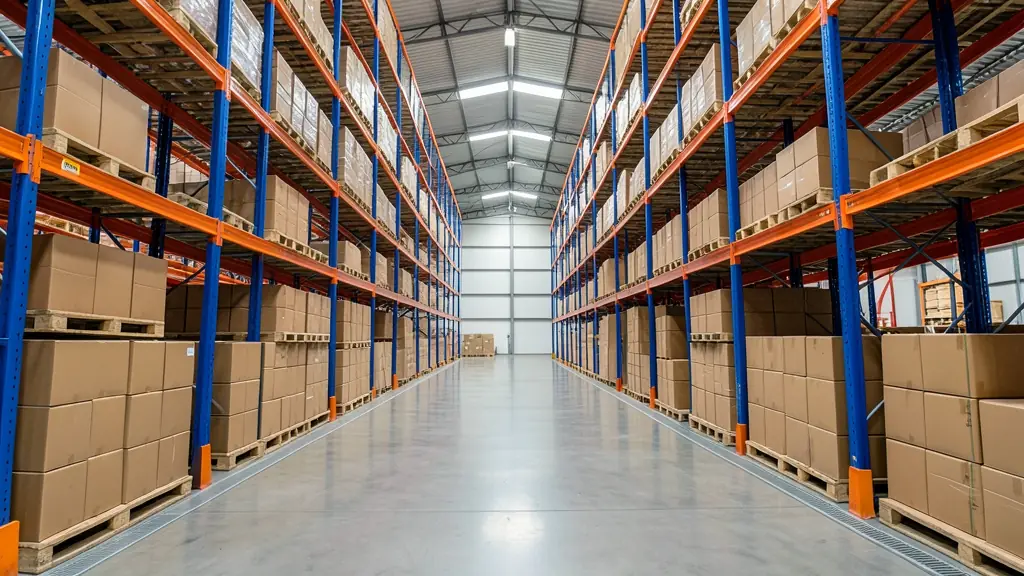
Narrow aisle racking is ordinary pallet racking set with narrower aisles between the runs, served by trucks that do not need room to turn. In a narrow aisle layout, reach trucks work in aisles narrower than a counterbalance forklift needs. In a very narrow aisle (VNA) layout, turret or man-up trucks run in guided aisles barely wider than the truck itself, and the racking goes much higher. Both give more pallet places on the same floor. Both also bring costs and rules of their own, which this page explains.
Narrow aisle or VNA
Narrow aisle (NA) layouts use reach trucks, which carry the load within their own footprint and turn in less space than a counterbalance forklift. The racking is standard pallet racking, and the gain comes from narrower aisles. VNA layouts go further: the truck does not turn in the aisle at all, because its forks swing to face either side. The aisles are much narrower and the racking can be taller. The truck maker gives the minimum aisle for each truck, and the racking layout is drawn around that figure, not the other way round.
Guidance and the floor
VNA trucks are guided along the aisle by steel rails fixed at the foot of the racking or by a wire buried in the floor. Because the truck lifts loads very high in a tight space, the floor must be very flat and level along each aisle; the floor flatness is specified for VNA, and many existing floors need grinding or a new slab. An engineer and the truck supplier should check the floor before anything is ordered. Transfer areas at the aisle ends, where trucks enter and leave, need careful layout.
Height, sprinklers and the building
Height is limited by the clear height of the building, the lift height of the truck and the sprinklers. Tall racking often needs in-rack sprinklers or a revised fire design, so bring in the fire installer early. Taller racking also puts heavier loads through each base plate. Installation of VNA racking demands tighter tolerances for plumb and alignment than standard racking. Lighting in the aisles, pedestrian rules (people and VNA trucks should not share an aisle) and end of aisle protection belong in the plan from the start.
When it makes sense
Narrow aisle storage pays off when floor space is expensive or the building cannot grow, and when you hold many product lines that each need direct access. Weigh the cost of the trucks, guidance and floor work against the pallet places gained or a move to a bigger building. For fewer lines with many pallets each, drive-in racking may be cheaper. Ask the supplier for a drawing of your floor in a standard layout and a narrow aisle layout, with the pallet count for each, so the decision rests on your own building.
What to put in your request
- Building size, clear height and column grid
- Number of pallet places you need
- Trucks you have now or plan to buy
- Age and condition of the floor slab
- Sprinkler type and position under the roof
Narrow Aisle Racking for warehouses, shops, workshops and homes
- Warehouses and distribution centres: tall VNA runs in a distribution centre that cannot grow its floor
- Factories and manufacturers: narrow aisles to fit more raw material and finished goods inside the factory
- Shops, supermarkets and spaza shops: used in the regional distribution centres that supply chain stores
- Wholesalers and building supply yards: reach truck aisles to add pallet places in a crowded depot
- Workshops, contractors and trades: seldom needed in a workshop
- Offices, archives, schools and hospitals: not used for office storage
- Restaurants, caterers and wine cellars: seldom used, sometimes in a large food distributor's dry store
- Homeowners: not used at home
- Farms, packhouses and co-ops: rarely, sometimes in a large co-op or packhouse store
Frequently asked questions
Do you design or install narrow aisle racking?
No. We pass your request to independent racking suppliers, designers and installers who work in your area, and they quote you directly. We give no engineering advice and sell nothing ourselves.
Can I use my existing forklifts in narrow aisles?
Counterbalance forklifts need wide aisles to turn, so narrow aisles normally mean reach trucks, and VNA means turret or man-up trucks. Ask the supplier and the truck dealer to check what your fleet can do, and whether hiring or leasing VNA trucks makes more sense than buying them.
Does my floor have to be replaced for VNA?
Not always, but VNA needs a very flat floor along each aisle. A floor survey shows whether grinding is enough or a new slab is needed. Have this checked before you commit to VNA.
How much more will narrow aisle racking store?
It depends on your building, the aisle widths your trucks need and how high you can go. A supplier can draw your floor both ways and count the pallet places, which is the honest way to compare.
Narrow Aisle Racking by province and city
- Johannesburg
- Pretoria
- Centurion
- Midrand
- Sandton
- Randburg
- Roodepoort
- Krugersdorp
- Randfontein
- Germiston
- Boksburg
- Benoni
- Kempton Park
- Alberton
- Vanderbijlpark
- Vereeniging
- Durban
- Pinetown
- Pietermaritzburg
- Richards Bay
- Newcastle
- Ladysmith
- Gqeberha (Port Elizabeth)
- East London
- Kariega (Uitenhage)
- Mthatha
- Cape Town
- Bellville
- Paarl
- Stellenbosch
- George
- Worcester
- eMalahleni (Witbank)
- Middelburg
- Secunda
- Mbombela (Nelspruit)
- Rustenburg
- Brits
- Klerksdorp
- Potchefstroom
- Mahikeng
- Polokwane
- Tzaneen
- Kimberley
- Upington
- Bloemfontein
- Welkom
- Sasolburg