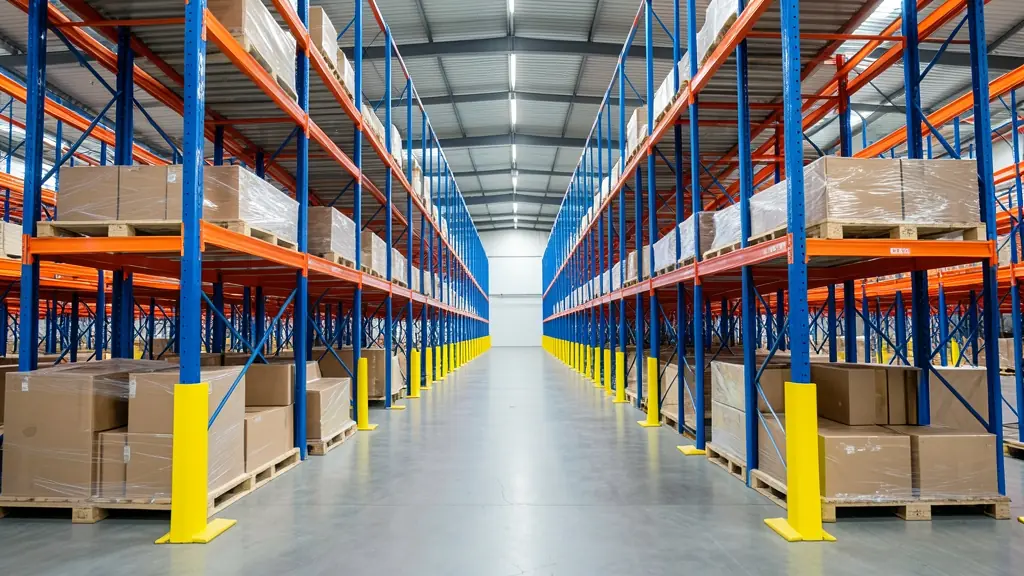
Pallet racking is the backbone of most warehouses and factory stores in South Africa. The common kind is adjustable selective racking: upright frames joined by pairs of beams at levels you can move, with every pallet reachable by forklift. It is simple, it suits almost any stock on pallets and it grows bay by bay. This page explains how it is built, how loads are rated, how high you can go with your forklift and what a supplier needs from you to quote properly.
How it is built
A frame is two uprights braced together, with a base plate under each. Pairs of beams hook into slots in the uprights and are held by safety locks or clips so a forklift cannot lift them out. Each pair forms a level, and the levels can be moved up or down in steps when your stock changes. A bay commonly holds two or three pallets per level, and bays share frames along a run. Back to back runs are joined by row spacers.
Loads and pallets
The maker rates the racking per beam pair and per bay, and those figures go on a load notice on the end of the run. The common South African pallet is 1,200 x 1,000 mm and the European pallet is 1,200 x 800 mm, so tell the supplier which you use and which way the pallets go into the bay. Many pallet loads are around 500 to 1,000 kg, but check your heaviest pallet and size the beams to that, not to an average. Pallet support bars or wire mesh decks help with weak pallets and loose cartons.
Height, forklifts and the slab
Height is set by the building's clear height under the roof and sprinklers, and by how high your forklift or reach truck can lift with a load. Counterbalance forklifts need wider aisles than reach trucks, and the truck maker gives the minimum aisle. Taller and heavier racking puts more load through the base plates, so the slab thickness and condition matter, and an engineer may need to confirm them. If space is the problem, look at narrow aisle racking or a layout design.
Installation and upkeep
Trained installers set out the runs to the drawing, plumb and level the frames with shims, fit the beam locks and anchor the base plates to the slab, then fix the load notices. See racking installation for the steps. Fit column guards and end barriers where forklifts turn, and have the racking inspected regularly once it is loaded. Ask your staff to report every knock, keep the aisles clear, and never let anyone climb the racking or move beams with stock still on them.
What to put in your request
- Pallet size and which way it goes into the bay
- Heaviest pallet weight and loaded pallet height
- Number of pallet places you need now and later
- Clear height under the roof and sprinklers
- Forklift or reach truck type and its lift height
Pallet Racking for warehouses, shops, workshops and homes
- Warehouses and distribution centres: runs of selective racking for mixed stock with every pallet reachable
- Factories and manufacturers: racking for raw material in, finished goods out and work in progress between
- Shops, supermarkets and spaza shops: a few bays of racking in the receiving area behind a large store
- Wholesalers and building supply yards: racking for cases, bags and drums in a cash and carry or depot
- Workshops, contractors and trades: a short run of racking for drums, heavy spares and steel stock
- Offices, archives, schools and hospitals: rarely needed, sometimes for archive boxes on pallets in a basement store
- Restaurants, caterers and wine cellars: racking in a caterer's or food distributor's dry store for pallets of stock
- Homeowners: seldom used at home, sometimes a single bay in a large workshop or shed
- Farms, packhouses and co-ops: racking in packsheds and feed stores for bags, bins and pallets of produce
Frequently asked questions
Do you supply or install pallet racking yourselves?
No. We pass your request to independent racking suppliers and installers who work in your area, and they quote you directly. We do not make, sell or install racking, and we give no engineering advice.
How many pallets fit in one bay?
Most bays take two or three pallets per level, depending on the beam length and pallet size. Multiply by the number of levels for the bay total. The supplier works this out from your pallet size and the height of the building.
Can I mix beams and frames from different racking?
Usually not. Beams from one maker do not always lock properly into another maker's uprights, and the load rating only applies to the system as tested. Ask the supplier to match the system you already have, or to confirm in writing which parts are compatible and what the combined rating is.
What should I send for a quote?
Send the pallet size, the heaviest pallet weight and height, the number of pallet places you need, the clear height of the building and the forklift you use. A sketch of the floor with doors and columns helps a great deal.
Pallet Racking by province and city
- Johannesburg
- Pretoria
- Centurion
- Midrand
- Sandton
- Randburg
- Roodepoort
- Krugersdorp
- Randfontein
- Germiston
- Boksburg
- Benoni
- Kempton Park
- Alberton
- Vanderbijlpark
- Vereeniging
- Durban
- Pinetown
- Pietermaritzburg
- Richards Bay
- Newcastle
- Ladysmith
- Gqeberha (Port Elizabeth)
- East London
- Kariega (Uitenhage)
- Mthatha
- Cape Town
- Bellville
- Paarl
- Stellenbosch
- George
- Worcester
- eMalahleni (Witbank)
- Middelburg
- Secunda
- Mbombela (Nelspruit)
- Rustenburg
- Brits
- Klerksdorp
- Potchefstroom
- Mahikeng
- Polokwane
- Tzaneen
- Kimberley
- Upington
- Bloemfontein
- Welkom
- Sasolburg